A proper wrap is a pitched frame, a tensioned perimeter band, 7-mil film welded into a single shell, and enough ventilation to keep the air moving. Skip any one of those and you get pooled water, chafed gelcoat, or a boat that opens up in April smelling like a basement.
When off-season weather settles in over Long Island, unprotected boats face freezing precipitation, aggressive UV exposure, and relentless wind. Leaving a boat open to it — or relying on an ill-fitting cover — leads to gelcoat oxidation, cracked upholstery, and structural damage from pooled water. A properly applied marine wrap creates a drum-tight shell that keeps the deck and hull intact until spring launch.
Why Shrink Wrap Beats a Tarp
Boaters go back and forth between a blue hardware-store tarp, a factory mooring cover, and heavy-duty shrink film. Tarps look inexpensive right up until they whip in a gale, scratch gelcoat, and collect standing water that collapses the framework underneath. Factory canvas covers fit better, but heavy snow stretches the fabric, pops snaps, and lets moisture seep through saturated seams.
Marine Shrink Wrap
- Snow shedding: excellent — a taut slope forces runoff before it can freeze
- Wind flap: none, the film is heat-welded into one piece
- Chafe: very low — a static fit means nothing rubs the gelcoat
- Water: a single monolithic barrier with no open edges
- Lifespan: one season, longer if you modify it carefully in spring
- Fit: contours exactly around hardware, arches, and consoles
Standard Poly Tarp
- Snow shedding: poor — it sags and forms ice pockets
- Wind flap: high, and it tears out its own grommets
- Chafe: very poor, it will scratch gelcoat all winter
- Water: inconsistent, with gaps at every edge
- Lifespan: one season, often shredded well before spring
- Fit: loose and boxy
Canvas Mooring Cover
- Snow shedding: fair — it stretches under a heavy load
- Wind flap: low to moderate
- Chafe: moderate wear at the contact points
- Water: water-resistant, but not sealed
- Lifespan: three to seven years
- Fit: tailored to the factory profile
Moisture Defense, UV Inhibitors, and Snow Load
High-grade marine films are made from 100% virgin low-density polyethylene (LDPE) combined with chemical UV inhibitors. Those stabilizers keep the polymer chains from degrading and going brittle over months of direct sun.
Beyond blocking external moisture, corrosion inhibitor films incorporate Volatile Corrosion Inhibitors (VCI). VCI films release harmless microscopic vapors inside the enclosed space to protect ferrous and non-ferrous engine components, deck hardware, and marine electronics from rust and oxidation.
Paired with a solid internal spine, the heated cover forms a tensioned tent that sheds heavy, wet snow on its own. For more cold-weather maintenance routines, browse our marine maintenance articles.
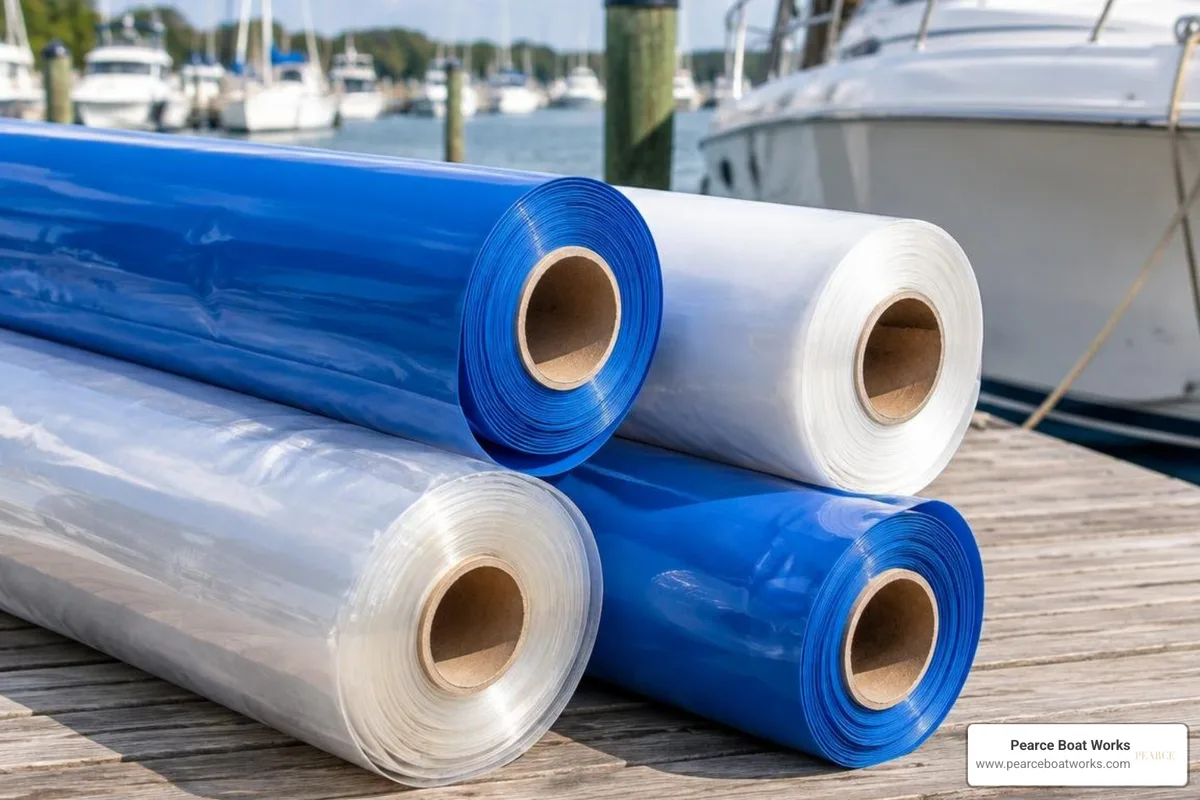
Choosing the Right Film: Thickness, Color, and Size
Getting the material specification right is what prevents torn seams, hull abrasions, and a collapsed frame in February.
Mil Thickness
Shrink film thickness is measured in mils (thousandths of an inch):
- 6-mil film: light duty — small runabouts, jet skis, or short-term transport in mild climates.
- 7-mil film: the marine industry standard for outdoor winter storage. Excellent tensile strength and puncture resistance for powerboats, sailboats, and center consoles. This is what we use.
- 8.5-mil to 10-mil film: heavy gauge for commercial vessels, large yachts, structural containment, or anything exposed to severe coastal gales.
Film Color
Color is functional, not cosmetic:
- White: reflects solar energy, keeps internal temperatures down, minimizes condensation. The best all-around choice here.
- Blue: absorbs solar radiation and warms the envelope, which helps melt snow and ice buildup in colder northern yards.
- Clear: lets daylight in for off-season maintenance or display, but demands diligent airflow management or it turns into a greenhouse.
- Flame-retardant (FR): treated for safety when hot work, painting, or active repairs are happening nearby.
Measuring Accurately
To calculate the roll width you need, take your boat's Length Overall (LOA), beam width, and bridge clearance — the height from the rub rail to the highest fixed point, whether that's a center console windscreen, a radar arch, or a cabin top.
Always add 10% to 15% for overlap and hemming. Marine films are center-folded on the roll, which makes unrolling and positioning across a wide deck manageable even with a small crew.
Frame Building and Preparation
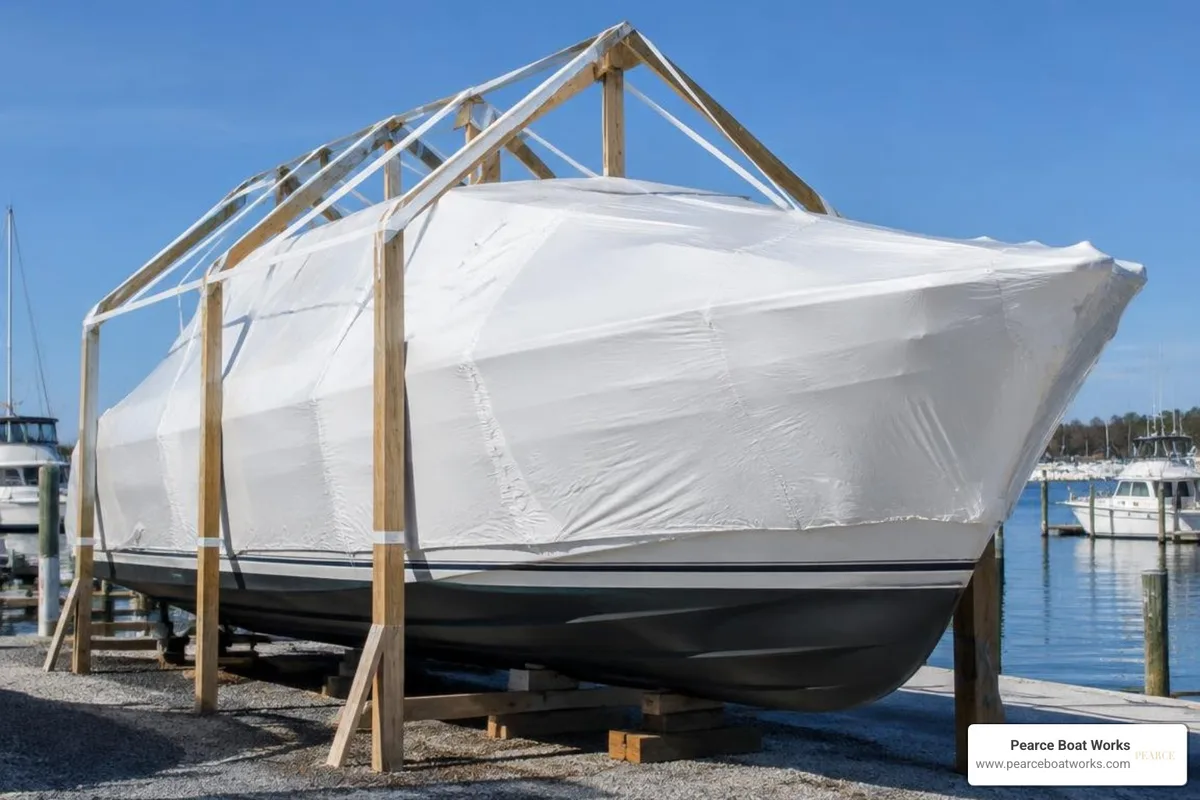
A shrink wrap skin is only as good as the skeleton under it. Without a pitched structure, water pools, freezes into heavy ice sheets, and tears the cover open.
Supplies and Tools
- Propane heat tool: a specialized heat gun on a propane tank with an adjustable regulator.
- Woven polyester strapping: high-tensile, typically 3/4-inch, for the perimeter band and support grid.
- Metal buckles and a tensioner: heavy-duty wire buckles and a manual ratchet to pull the band drum-tight.
- Heat-shrink tape and spray adhesive: 2-inch to 4-inch marine preservation tape for welding seams and sealing perimeter folds.
- Padding: foam pipe insulation, carpet remnants, or felt pads to cap sharp cleats, windshield corners, and rod holders.
- Safety gear: heat-resistant gloves, goggles, long-sleeved natural-fiber (cotton) clothing, and an ABC fire extinguisher within reach.
Building the Support Structure
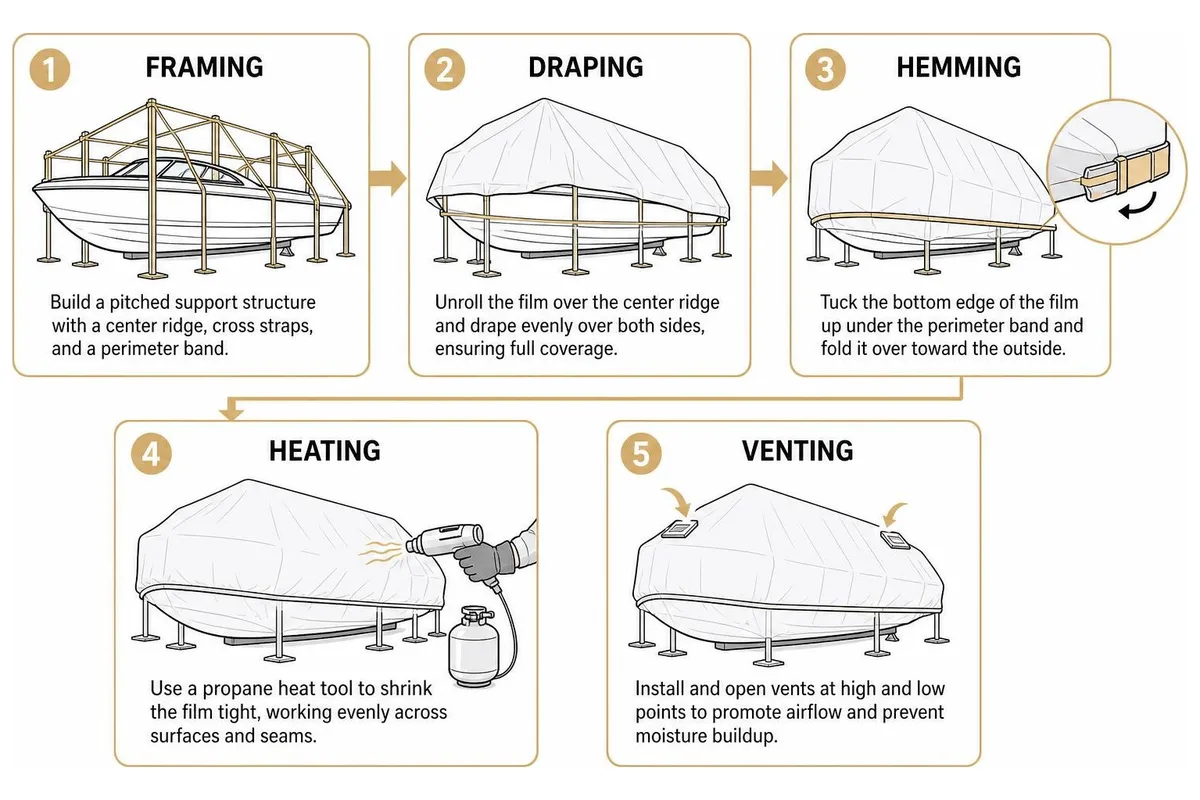
Start with a rigid center ridge running bow to stern, using 2x4 uprights roughly every 6 to 8 feet along the deck centerline.
- Protect the base: set uprights on carpet scraps or wide base plates so you don't scratch gelcoat or crush teak.
- Establish the pitch: the central ridge needs a pitch of at least 1-in-4 (a 25% grade). That slope is what moves snow and rain off.
- Run ridge straps: secure a taut line of polyester strapping along the tops of all support posts, bow cleat to stern.
- Build lateral ribs: run cross-strapping every 3 to 4 feet from the center ridge down to the stanchions, rails, or cleats to form a dome-like grid.
- Install the perimeter band: tie a continuous loop of strapping around the hull just below the rub rail and cinch it with a buckle and tension tool.
- Pad every hard point: antenna mounts, outriggers, hardware brackets, sharp windshield corners — dense foam on all of it.
You can secure the film with either a strap-down method (folding the film around the perimeter band and securing with clips and heat) or a tape-down method (preservation tape directly against the hull). Either way, the ventilation plan below is what determines whether the boat stays dry.
Installation, Step by Step
Once the frame is secure and padded, work on a calm day with winds under 10 mph.
Draping, Seaming, and the Perimeter Hem
- Roll out the film: unroll it over the center ridge with equal lengths draping port and starboard.
- Align and center: confirm the film extends at least 8 to 12 inches below the perimeter strapping on all sides.
- Form the hem: starting at the stern, tuck the bottom edge up under the polyester band, folding it over itself toward the outside.
- Tack the seams: use preservation tape or brief pulses of the heat tool to tack the folded hem in place around the entire hull.
- Trim the excess: cut away bunched plastic at the bow and transom, leaving a clean 6-inch overlap for welding.
Heat, Ventilation, and an Access Door
- Heat the perimeter hem first: light the heat tool and keep the nozzle moving in a steady side-to-side sweep. Lock the plastic tight around the perimeter strap before anything else.
- Shrink the hull sides: sweep from the bottom upward, holding 12 to 18 inches of working distance. The film will visibly tighten and smooth.
- Shrink the roof: from a sturdy ladder, work from the lower edge up toward the peak. Never hold the gun in one spot — concentrated heat burns straight through.
- Install passive louvre vents: cut small inverted "U" slits and fit self-adhesive weatherproof louvre vents. Place them in pairs on opposing sides near bow and stern, plus one high vent near the peak, so air actually crosses the boat instead of sitting.
- Hang desiccant bags: put moisture-absorbing bags in the cabin and cockpit to pull residual humidity out of the air.
- Add an access door: if you'll need to get aboard, tape a zipper door onto a flat vertical section such as the transom. Unzip it, slice the plastic behind it, tape the edges, and zip it closed.
Frequently Asked Questions
Can boat shrink wrap be reused or recycled?
Most installations are a single-season solution. That said, if you cut the lower hem band carefully in spring without slicing the main body, the wrap can sometimes go two or three seasons on a smaller runabout. For disposal, marine shrink wrap is #4 low-density polyethylene (LDPE) and can be bundled for dedicated marina recycling programs instead of going to landfill.
Is DIY or professional wrapping the better call?
DIY means buying a roll of film, strapping, buckles, tape, vents, and a propane heat tool kit — the tool kit is the part people underestimate, and it only pays off if you're wrapping every year. Professional wrapping is priced by the linear foot and varies with beam width, cabin height, and accessories. Our current winter rates are on the winter storage page. The real trade is equipment cost and time against the risk of burned gelcoat or a frame that lets go in a January storm.
How do I prevent mildew and condensation under the wrap?
Mildew thrives in dark, damp, unventilated spaces. Make sure the interior is completely dry before wrapping. Prop open every interior locker, bilge access hatch, and head door. Install at least one passive vent per 10 feet of boat length, and hang desiccant bags in enclosed cabin areas.
Before You Wrap
Protecting a boat through a Long Island winter comes down to preparation, a frame that holds its pitch, and airflow. Doing it yourself can be a satisfying project — but improper heat application or a weak support frame is how you end up with burned gelcoat, a collapsed frame, and moisture damage that costs more than the wrap ever did.
At Pearce Boat Works in Amityville, our in-house master mechanic and crew handle seasonal work start to finish: heavy-duty internal frames, commercial-grade 7-mil virgin film, and a ventilation layout built for the boat in front of us. If you'd rather hand it off, our winter storage services are open for the season.