Types of Boat Storage Units: Outdoor, Covered, and Enclosed
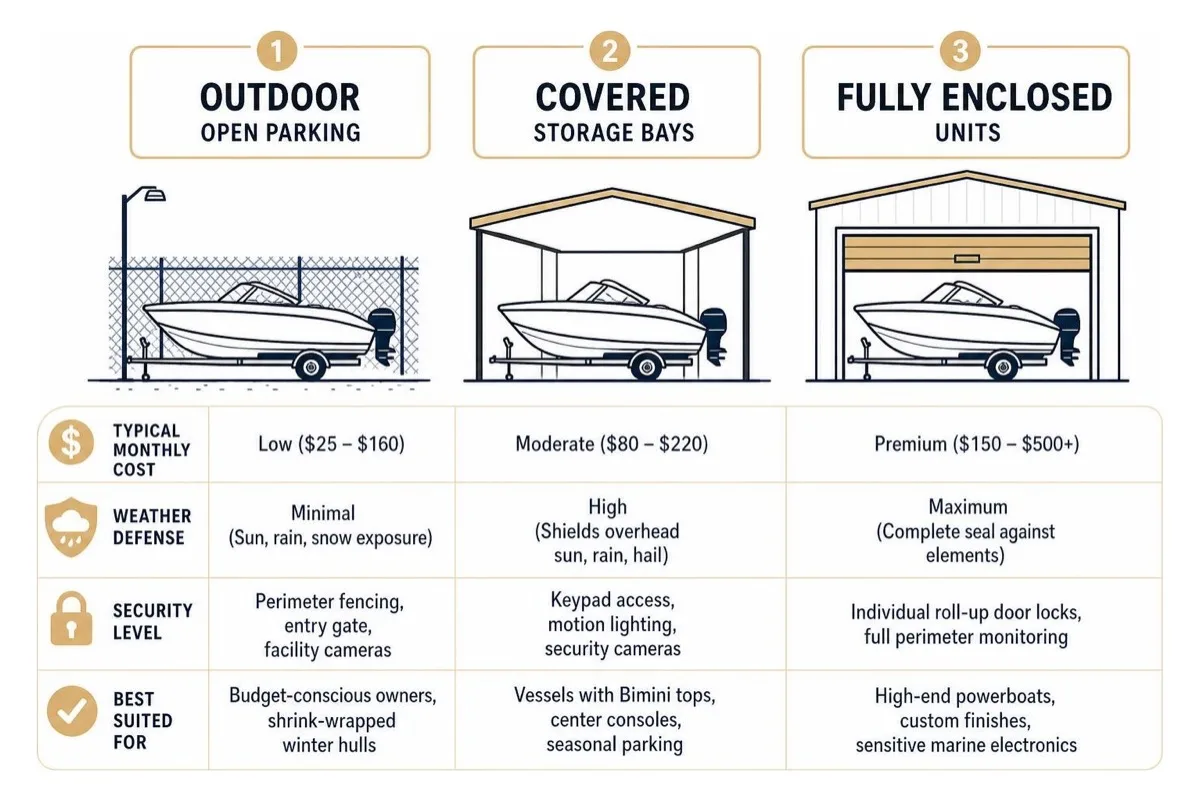
Finding the right physical setup for your vessel on land comes down to balancing protection, budget, and accessibility. Modern facilities generally categorize their spaces into three main formats: outdoor open parking, covered bays, and fully enclosed dry units.
Storage Type | Typical Monthly Cost | Weather Defense | Security Level | Best Suited For ---|---|---|---|--- Outdoor Open Parking | Lowest cost | Minimal \\(Sun, rain, snow exposure\\) | Perimeter fencing, entry gate, facility cameras | Budget-conscious owners, shrink-wrapped winter hulls Covered Storage Bays | Mid-range cost | High \\(Shields overhead sun, rain, hail\\) | Keypad access, motion lighting, security cameras | Vessels with Bimini tops, center consoles, seasonal parking Fully Enclosed Units | Highest cost | Maximum \\(Complete seal against elements\\) | Individual roll-up door locks, full perimeter monitoring | High-end powerboats, custom finishes, sensitive marine electronics
Outdoor Open Parking
Outdoor parking is the most accessible and budget-friendly format available. Vessels sit in designated, numbered stalls on paved, gravel, or graded surfaces. While open spaces carry the lowest monthly overhead, your boat remains fully exposed to UV radiation, fluctuating coastal temperatures, precipitation, and winter freeze-thaw cycles.
If you opt for an open parking stall in the Northeast during the winter months, high-grade marine shrink-wrapping and heavy-duty trailer wheel locks are essential to prevent weather intrusion and deter opportunistic theft.
Covered Storage Bays
Covered storage bays provide a roof overhead while leaving the access drive open, with many structures offering solid sidewall shielding along three sides. These canopy structures block direct sunlight, preventing fiberglass gelcoat oxidation, cracked upholstery, and fading canvas covers.
Covered bays also prevent heavy snow or standing rainwater from pooling in cockpits and engine compartments, all while allowing cross-ventilation that minimizes interior condensation and mildew growth.
Fully Enclosed Dry Storage
Fully enclosed storage units resemble oversized, private garages designed specifically for marine vessels and large vehicles. Fitted with heavy-duty roll-up or swing doors, these spaces deliver total physical protection against extreme weather, high winds, pests, and unauthorized access.
Enclosed spaces give you total privacy, dedicated four-wall shelter, and a dry environment to park your rig. For vessels featuring expensive navigation electronics, custom paintwork, or sensitive interior finishes, an enclosed bay provides maximum security and peace of mind.
Sizing and Measurement: Choosing the Right Dimensions
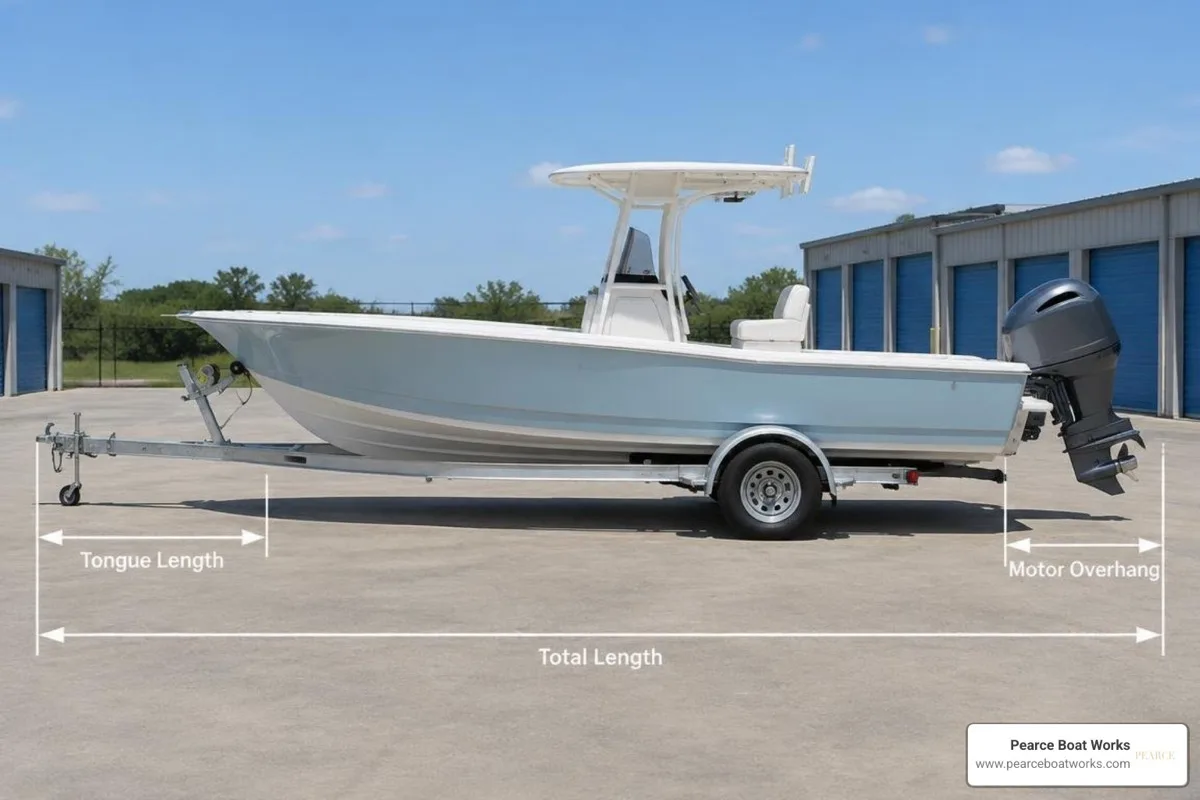
A common mistake boat owners make when reserving a space is booking based strictly on the manufacturer's stated boat length \\(the length overall or LOA\\). A 24-foot center console rarely takes up only 24 feet of physical space once mounted on a road trailer.
Sizing Guide for Boat Storage Units
Facilities offer spaces ranging from compact 10x25-foot stalls up to expansive 15x40-foot and 15x50-foot layouts. When reviewing unit dimensions, door clearance is just as critical as floor footprint:
* Compact Spaces \\(10x20 to 10x25 ft\\): Ideal for personal watercraft \\(PWCs\\), jet boats, small skiffs, and shallow-draft duck boats. * Mid-Sized Units \\(12x30 to 12x35 ft\\): Accommodates standard runabouts, bass boats, wakeboard hulls, and center consoles up to 24 feet on single- or tandem-axle trailers. * Large & Premium Bays \\(14x40 to 15x50 ft\\): Designed for offshore center consoles, walkarounds, pontoon boats, and express cruisers. Wide bays \\(14–15 feet\\) provide comfortable room on both sides for easy trailer maneuvering.
Always pay close attention to vertical clearance. Roll-up doors with heights of 12 to 16 feet are standard in purpose-built marine units to clear wakeboard towers, radar arches, T-tops, and fixed Biminis without requiring teardown before backing in.
How to Accurately Measure Your Vessel and Trailer
To guarantee your rig fits cleanly inside a unit's footprint, measure the entire setup manually before booking:
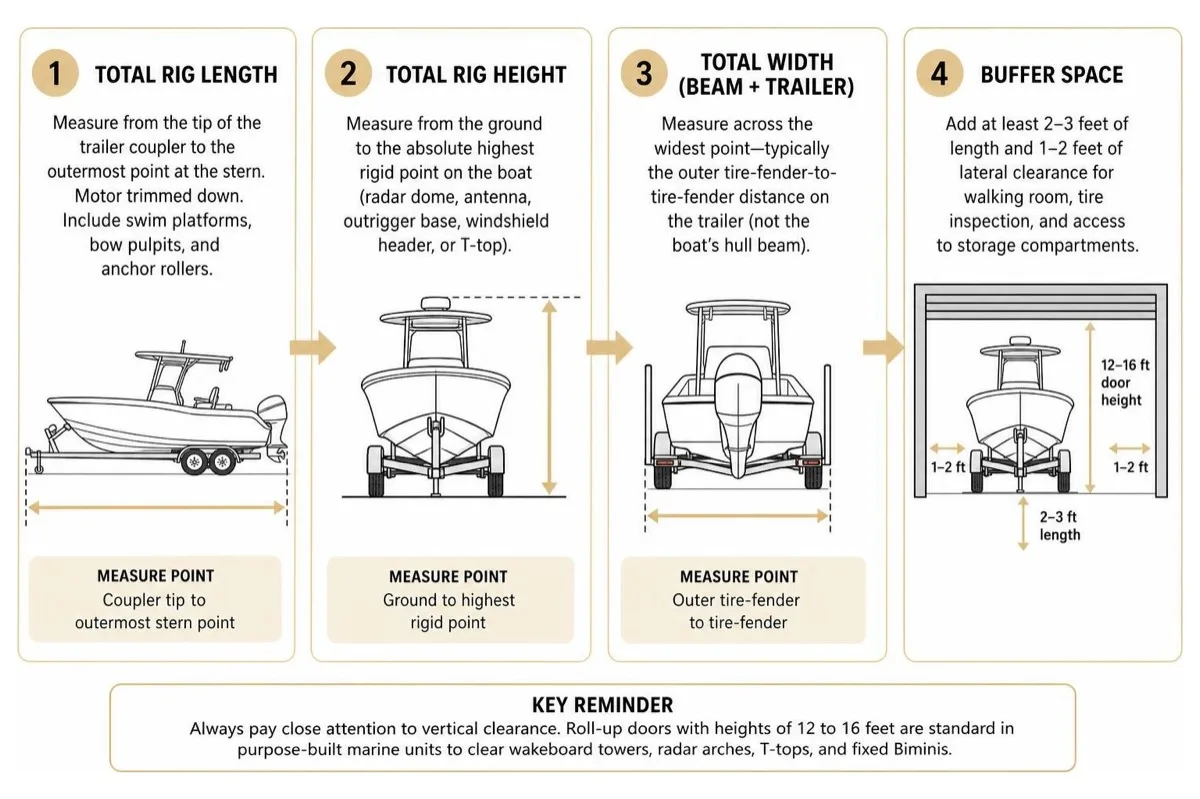
1. Total Rig Length: Measure from the tip of the trailer coupler \\(or tongue hitch\\) to the outermost point at the stern. Be sure to measure with the outboard motor trimmed down or in its resting trailering position. Include swim platforms, bow pulpits, and anchor rollers. 2. Total Rig Height: Measure from the ground to the absolute highest rigid point on the boat—whether that is an open radar dome, VHF antenna mount, outrigger base, or windshield header. 3. Total Width \\(Beam + Trailer\\): Measure across the widest point, which is typically the outer tire-fender-to-tire-fender distance on the trailer rather than the boat's hull beam. 4. Buffer Space: Add at least 2 to 3 feet of length and 1 to 2 feet of lateral clearance so you can walk around your boat, inspect tires, and access storage compartments without scraping walls.
Key Amenities, Security, and Facility Rules
Selecting a place to store your boat involves more than just finding an empty stall; the facility's amenities, infrastructure, and operating standards are just as critical for protecting your investment.
Essential Security Features and Contactless Access
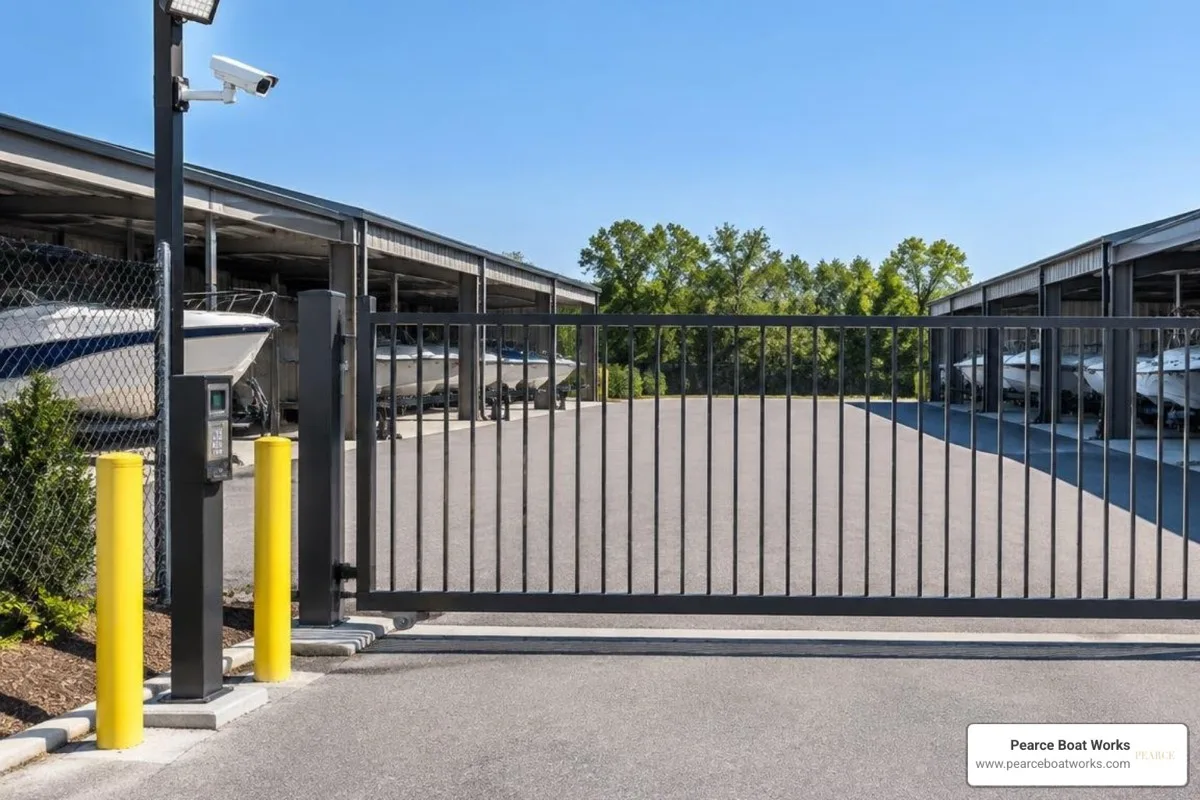
A reputable facility protects your property with multiple layers of perimeter and access security:
* Perimeter Fencing & Motion Lighting: Fully enclosed commercial perimeter fencing backed by bright, motion-activated LED lighting across every drive aisle. * Digital Video Surveillance: 24/7 CCTV cameras recording entrances, exits, and interior aisles. * Keypad Gate Access: Automated security gates that require a personalized PIN code for every entry and exit, creating an auditable access log. * Contactless Account Systems: Online move-ins, automated payment setups, and mobile-enabled gate control that allow you to manage storage access on your own schedule.
Power Hookups and Battery Trickle Charging
Marine deep-cycle and cranking batteries lose charge steadily over weeks of non-use. Many dedicated boat facilities provide 110V electrical outlets or dedicated 15-amp trickle-charging circuits.
These power points allow you to plug in smart battery maintainers to prevent deep-discharge damage without overloading facility breakers. When setting up long-term electrical maintenance, follow established routine marine maintenance guidelines to ensure your onboard electrical system remains safe and corrosion-free throughout layup. For additional reference on proper battery care during extended storage, the BoatUS Foundation offers practical guidance on marine electrical systems and seasonal maintenance.
Prohibited Items and Facility Policies
Storage operations enforce strict rules to protect the safety of all tenants and comply with environmental and local fire codes:
* Flammable Liquids & Hazardous Waste: Storing loose gasoline jugs, volatile solvents, open paint cans, or uncontained oils is universally prohibited. * No Living or Camping: Sleeping, camping, or living inside stored vessels or RVs on the premises is strictly forbidden. * Hot Work & Heavy Mechanical Overhauls: Facilities rarely allow engine pulling, grinding, open-torch cutting, or high-volume spray painting inside rented bays due to fire insurance rules. * Perimeter Footprint: All gear, anchors, spare tires, and personal items must remain inside the footprint of your rented bay or secured within your boat. Leaving equipment in open drive aisles is not permitted.
Comparing Costs and Value: Storage Units vs. Marina Dockage
Evaluating land storage against water dockage requires looking at both monthly rates and long-term maintenance costs.
Pricing Breakdown for Boat Storage Units
Storage rates vary based on location, space dimensions, and the level of structural enclosure:
* Uncovered Outdoor Parking: Stalls are the most affordable option, providing an economical base for shrink-wrapped boats on roadworthy trailers. * Covered Canopy Bays: Covered stalls carry a moderate premium over open parking, offering substantial sun and rain protection. * Enclosed Dry Units: Premium, garage-style units with electricity and roll-up doors command the highest monthly rates, depending on square footage and ceiling height.
Facilities frequently offer promotional incentives, such as discounted first-month move-in rates or percentage discounts for upfront 6-month or 12-month lease commitments.
Wet Slips vs. Dry Land Storage
During the active boating season, choosing between dry land parking and in-water dockage comes down to convenience versus maintenance:
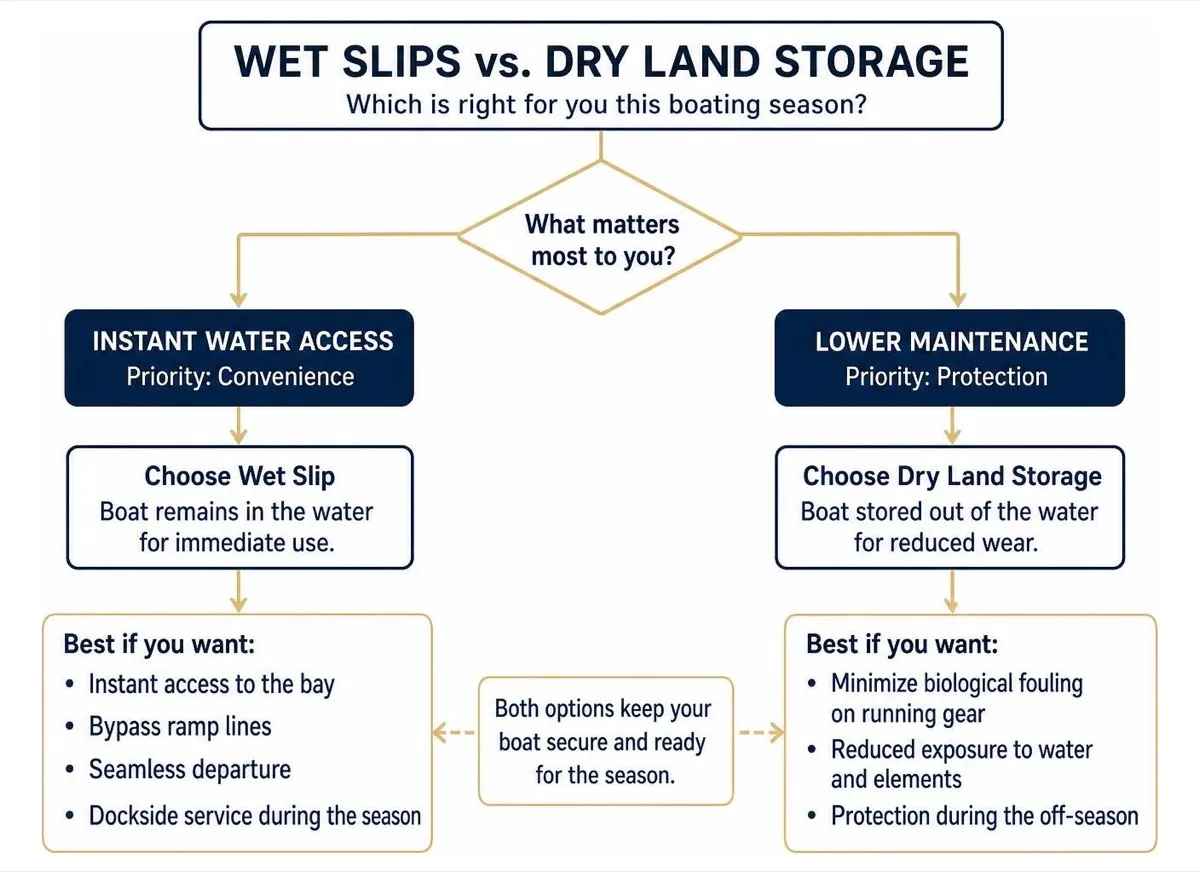
While dry storage minimizes biological fouling on your running gear, having your boat in the water provides instant access to the bay whenever weather permits. For local boaters who want to bypass ramp lines and enjoy seamless departure, exploring dedicated in-water slip rentals offers a practical balance between access and dedicated dockside service throughout the boating season.
Frequently Asked Questions About Boat Storage Units
Can I work on my boat while it is in a storage unit?
Most commercial facilities permit light, clean maintenance tasks—such as wiping down the hull, charging batteries, organizing fishing tackle, checking fluid levels, or upgrading electronics. However, major overhauls involving fuel tank drainage, engine rebuilding, heavy grinding, bottom sanding, or hull spray painting are typically barred by facility rules and fire codes. Check your lease agreement for specific guidelines on permitted on-site work.
What should I do to winterize my boat before moving it into storage?
Winter preparation is essential to prevent costly freeze damage and fuel degradation. Key steps include adding marine fuel stabilizer and running the engine to distribute it, completely draining raw water from engine cooling jackets, flushing the system with non-toxic marine antifreeze, fogging the cylinders, changing gearcase lubricants, and treating fresh-water systems.
Before parking your vessel, inspect your bilge pumps, disconnect the batteries, and review our comprehensive spring commissioning checklist so you are completely prepared for an effortless launch once warmer weather returns.
Do storage facilities require specialized boat insurance?
Yes. Almost all self-storage and marine facilities require proof of comprehensive and collision insurance alongside active vessel and trailer registrations before issuing access credentials. The facility's commercial insurance only covers its own buildings and grounds—it does not cover tenant vessels against vandalism, severe storms, fires, or incidental damage.
Conclusion
Securing dependable boat storage units protects your vessel's gelcoat, onboard electronics, and mechanical systems throughout the off-season. By matching your boat’s complete trailered dimensions to the right unit layout—and confirming that security features, access hours, and power hookups meet your standards—you can protect your marine investment and avoid unexpected repairs.
For boat owners seeking comprehensive care, Pearce Boat Works delivers trusted, professional marine support right here in Amityville, NY. From master-mechanic engine maintenance and electrical upgrades to fully managed professional winter storage solutions, our team handles every detail so your vessel is protected, maintained, and ready for the water next season.