What Does It Cost to Shrink Wrap a Boat in 2026?
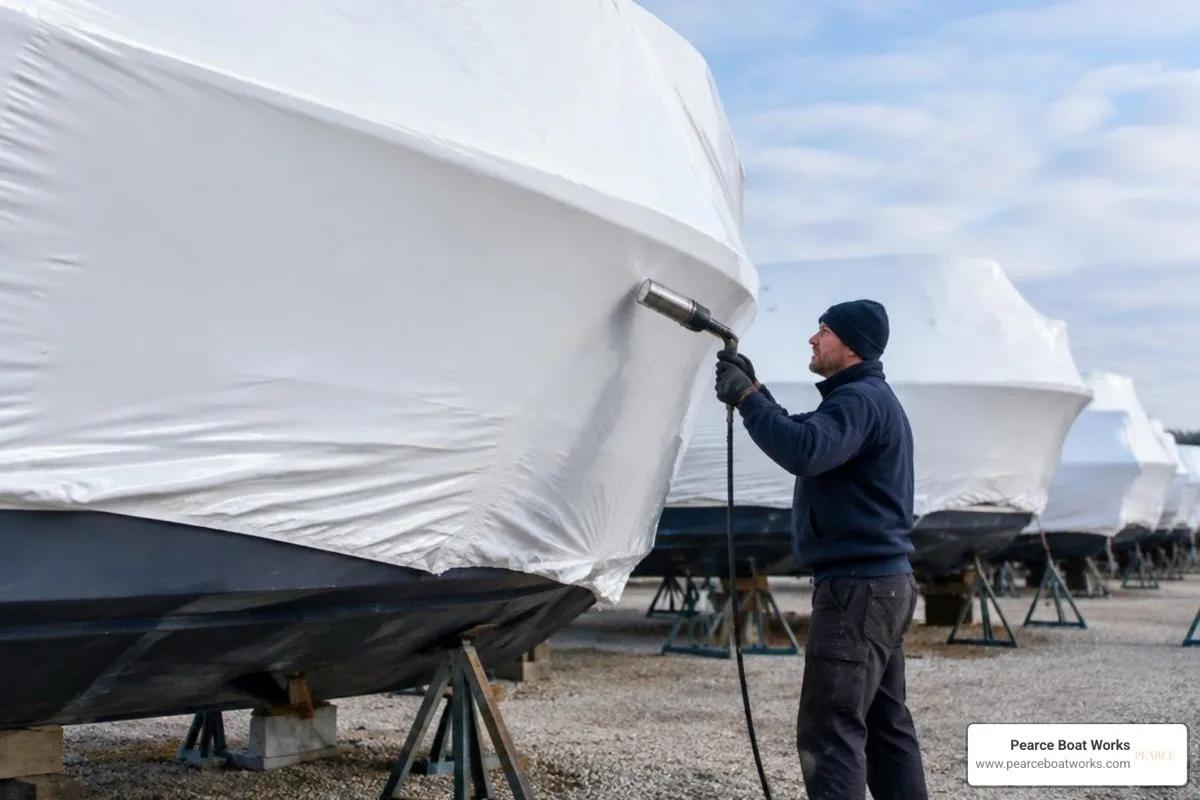
Boat shrink wrap is priced per foot of overall length, then adjusted for how complicated the boat is to cover. A narrow runabout sitting on its trailer lands at the bottom of the scale. A wide hull with a tower, hardtop, or flybridge lands at the top, because it needs more framing, more film, and more crew hours. Pearce Boat Works quotes shrink wrap boat by boat, so call 631.380.1800 with your length, beam, and top configuration for an exact figure.
Shrink wrap is usually a yearly winter storage expense , not a reusable cover. To compare prices, ask what the per-foot rate includes and whether vents, an access door, framing, and spring removal cost extra.
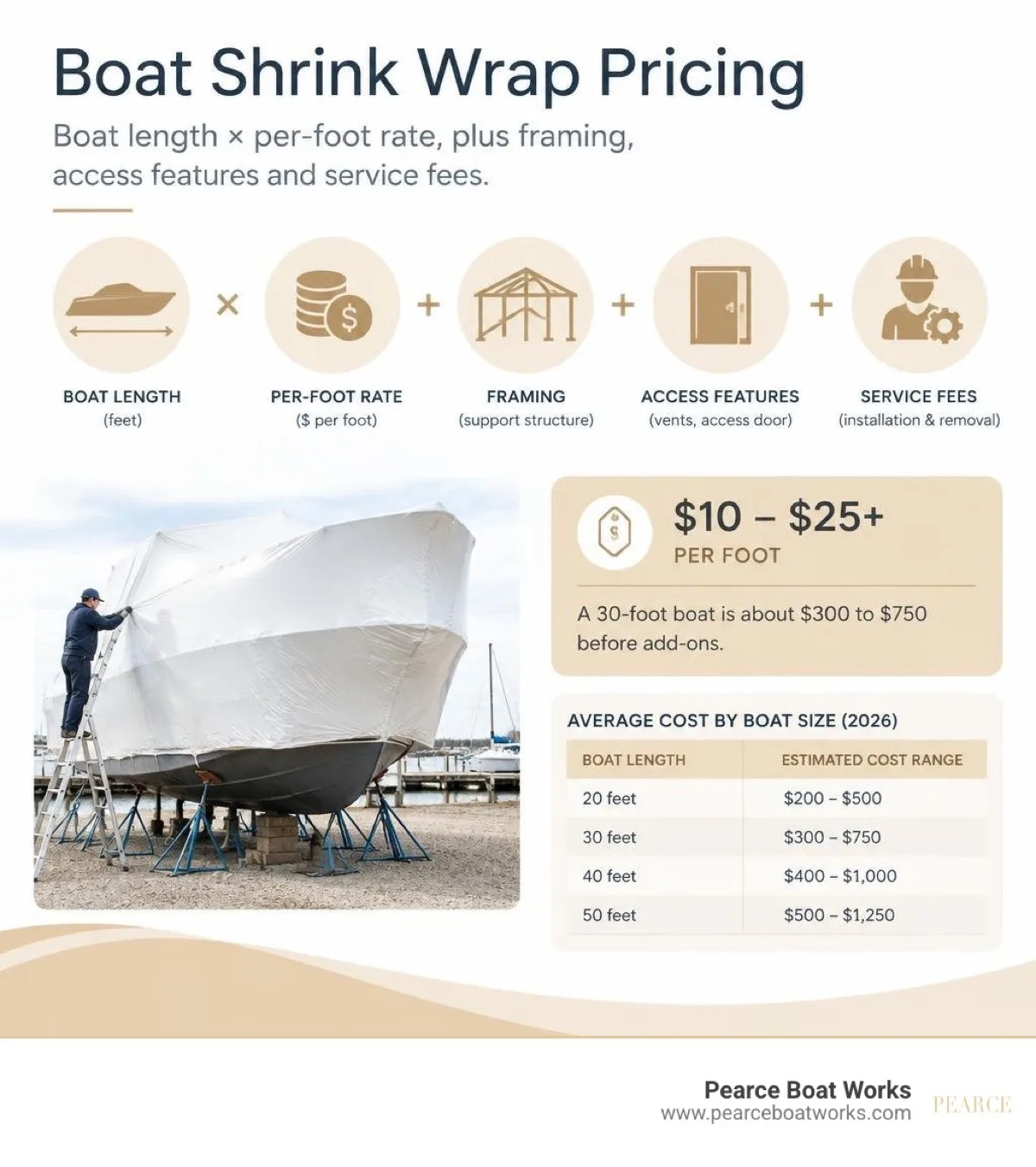
Average Boat Shrink Wrap Cost by Boat Size in 2026
When calculating your winter prep budget, base rates across the marine industry reflect standard linear footage. However, total project cost combines linear footage, hull beam, superstructure complexity, and the raw materials required to build a sturdy, shed-style support skeleton beneath the wrap.
Every yard sets its own per-foot rate, so the only number that matters is the one on your quote. What you can plan around is the shape of the pricing: the rate climbs as the boat gets longer, wider, and taller, and the final figure has to cover the framing and film needed to carry a Long Island snow load.
Boat Size Category | Where It Falls on the Per-Foot Scale | What Drives the Rate | Typical Hull Types Included ---|---|---|--- Small Boats \\(\ <25 ft\\) | Lowest | Single ridge pole, one roll of film, 1.5 to 3 crew hours | Skiffs, runabouts, small bowriders, bass boats Mid-Size Vessels \\(25–35 ft\\) | Moderate | Custom 2x4 framing for snow load, wider beam, 3 to 5 crew hours | Express cruisers, center consoles, walkarounds, pontoon boats Large & Complex \\(35–45+ ft\\) | Highest | Multi-tier strapping, scaffolding, heavier mil film, 4 to 8+ crew hours | Flybridges, sportfishers, offshore convertibles, motor yachts
For a figure you can actually budget against, call the yard with your boat's length, beam, and top configuration rather than working from an online average.
Small Boats Under 25 Feet
For skiffs, bowriders, aluminum utility rigs, and bass boats under 25 feet, shrink wrapping remains straightforward. These vessels feature low gunwales, modest beams, and minimal topside obstructions. Installers usually erect a single-ridge 2x4 support pole or strapping line down the center to pitch water and snow runoff before rolling out 60 to 90 linear feet of marine wrap.
Because setup takes between 1.5 to 3 hours, labor remains low. They are the least expensive hulls in the yard to wrap.
Mid-Size Vessels from 25 to 35 Feet
Stepping up to 25-to-35-foot dual consoles, express cruisers, center consoles, and deck hulls introduces higher labor demands. These crafts feature T-tops, outriggers, center consoles, and wider beams that require customized wooden 2x4 framing to handle regional snow loads without caving in.
Labor times rise to 3 to 5 hours. Specialty vessels like pontoons and wide deck boats also carry a flat surcharge for dual-pontoon strapping and broad square deck profiles. Zipper doors and extra vents are quoted on top of the base wrap.
Large Boats and Complex Hulls Over 35 Feet
Large motor yachts, convertible sportfishers, and flybridge cruisers demand comprehensive framing. Wrapping these hulls requires multi-tiered perimeter strapping, scaffolding, structural perimeter band cuts, and heavy-duty mil-thickness coverings.
Because technicians must navigate tall radar arches, hardtops, and outriggers, installation requires 4 to 8+ labor hours with multi-person crews. That crew time, rather than the film itself, is what makes large boats the most expensive hulls in the yard to wrap.
Key Variables and Add-Ons That Impact the Final Invoice
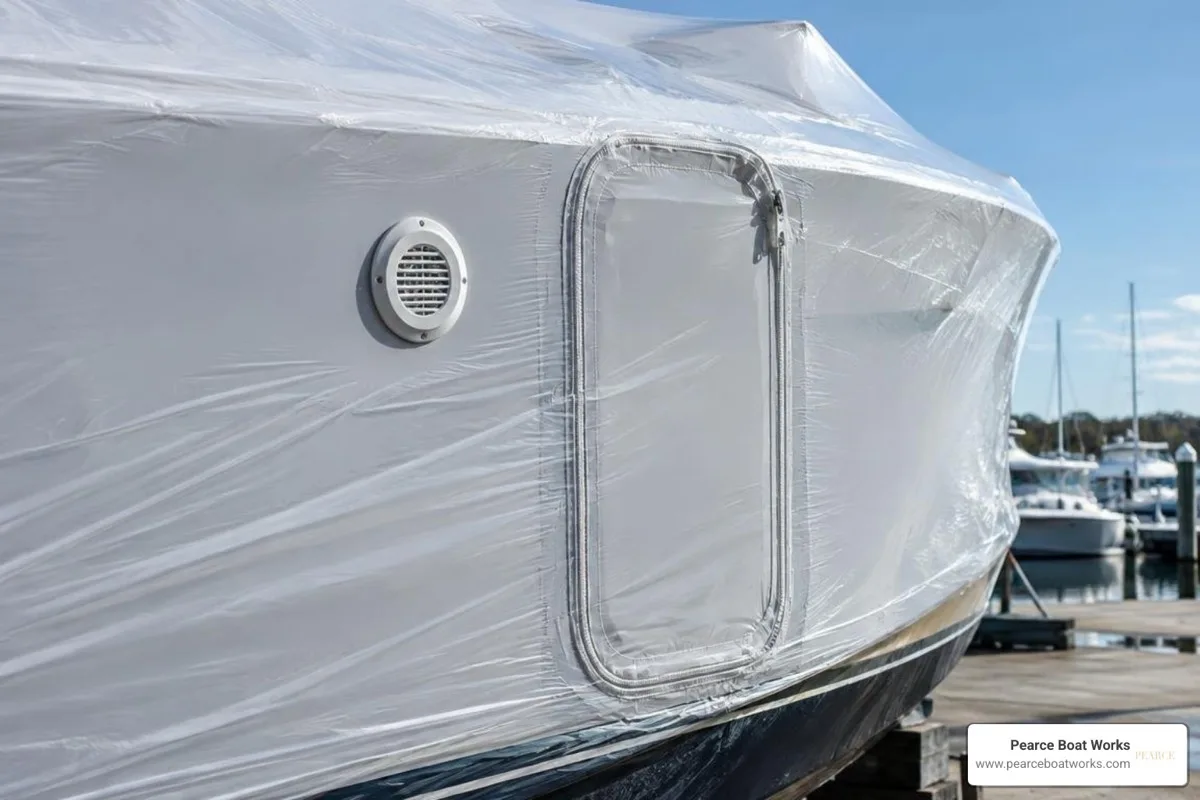
A headline per-foot rate rarely represents the entire final invoice. Base rates assume standard boat profiles on trailers with easy yard access. Several physical and operational factors will adjust that baseline.
Add-On Features That Increase Boat Shrink Wrap Cost
Accessories preserve your vessel's interior climate and allow off-season access.
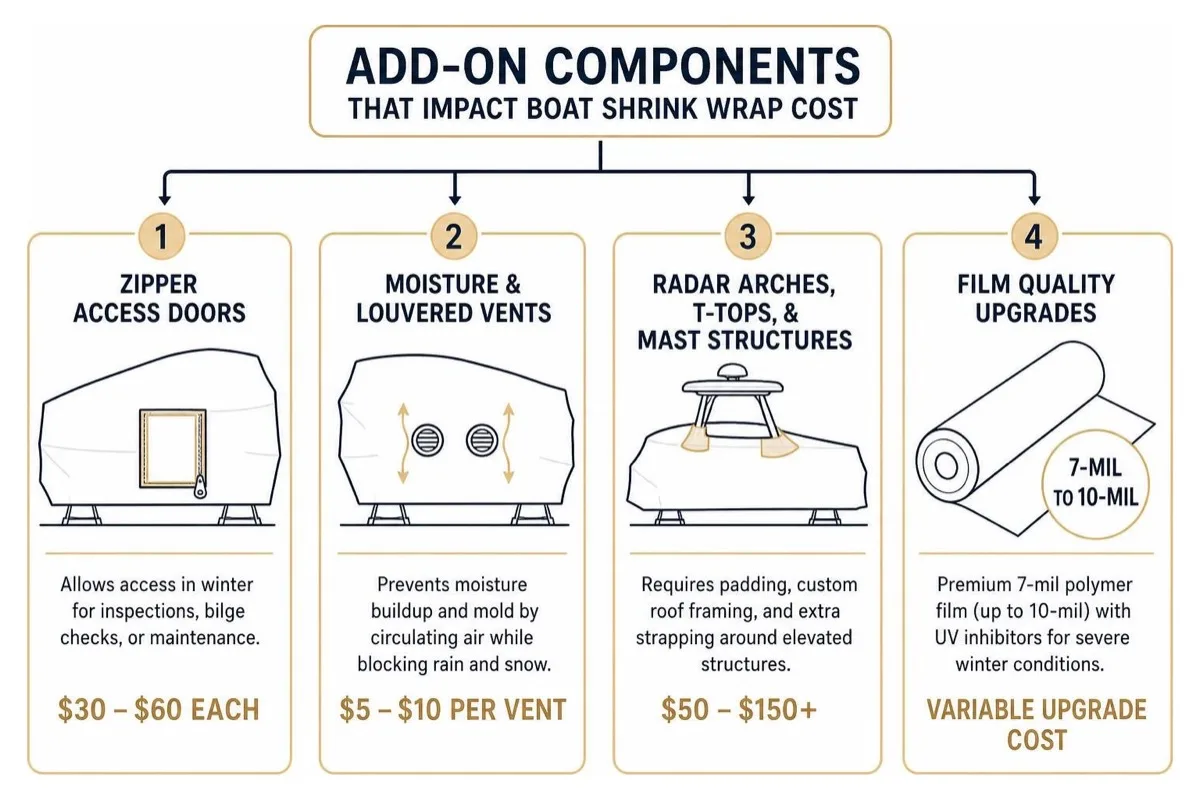
* Zipper Access Doors: A 30x36-inch or 30x48-inch zipper door allows you or your technicians to step inside during January or February to inspect bilges, run trickle chargers, or perform winter maintenance. * Moisture & Louvered Vents: A sealed plastic wrap without airflow creates a greenhouse effect that traps damp air, causing mold. Professional wraps incorporate 4 to 8 baffled weather vents to circulate air while barring rain and snow. * Radar Arches, T-Tops, & Mast Structures: Padding sharp edges, wrapping around radar domes, and building custom roof framing to support the film increases strapping and labor fees. * Film Quality Upgrades: Premium, heavy-duty applications use durable 7-mil polymer film \\(or up to 10-mil for severe winter conditions\\) formulated with UV inhibitors to withstand sun exposure and ice loads.
Regional Pricing and Marina Access Logistics
Location and yard logistics also impact marine pricing. Coastal urban boatyards face higher real estate, commercial insurance, and overhead costs, which translate into a 15% to 30% rate premium over inland operations.
Logistics also play a direct role. If your vessel sits in a tight marina slip, on high storage blocking, or in a cradle where technicians must tie belly bands directly under the keel rather than securing them to a trailer frame, expect a labor surcharge. Dedicated mobile wrapping services may also assess travel fees if your boat is located outside standard service zones.
Shrink Wrap’s Long-Term Costs
Shrink wrapping is an annual recurring seasonal expense rather than a multi-year asset. Because heat-shrinking stretches and permanently alters polymer memory, the plastic cannot be reliably tensioned a second time. It must be cut away and recycled each spring.
Because it is a yearly line item rather than a one-time purchase, the right way to evaluate shrink wrap is against what it protects: gelcoat, canvas, electronics, and upholstery that cost far more to repair than a season of film. Larger and more complex hulls carry a higher annual figure because they need more framing, but they are also the boats with the most exposed equipment to lose.
Shrink wrap delivers an airtight, drum-tight barrier engineered to support heavy snow loads, shed pooling water, and prevent rodent intrusion throughout harsh coastal winters. For owners who prefer a professionally managed seasonal solution, Pearce Boat Works offers full-service winter storage that includes structural framing and wrap protection.
Professional Service vs. DIY: The True Cost and Risk Analysis
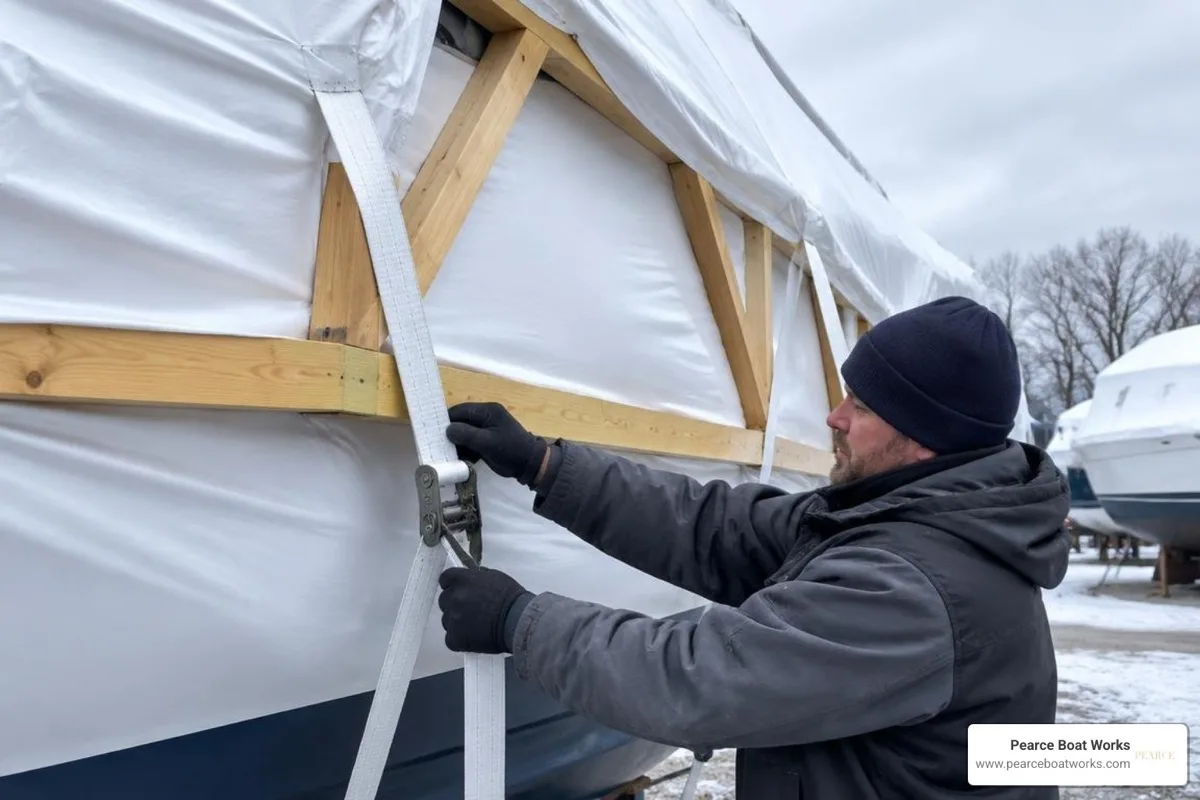
Many owners consider DIY shrink wrapping to reduce their annual maintenance budget. While DIY kits save on third-party labor, the initial equipment investment and steep learning curve alter the financial equation.
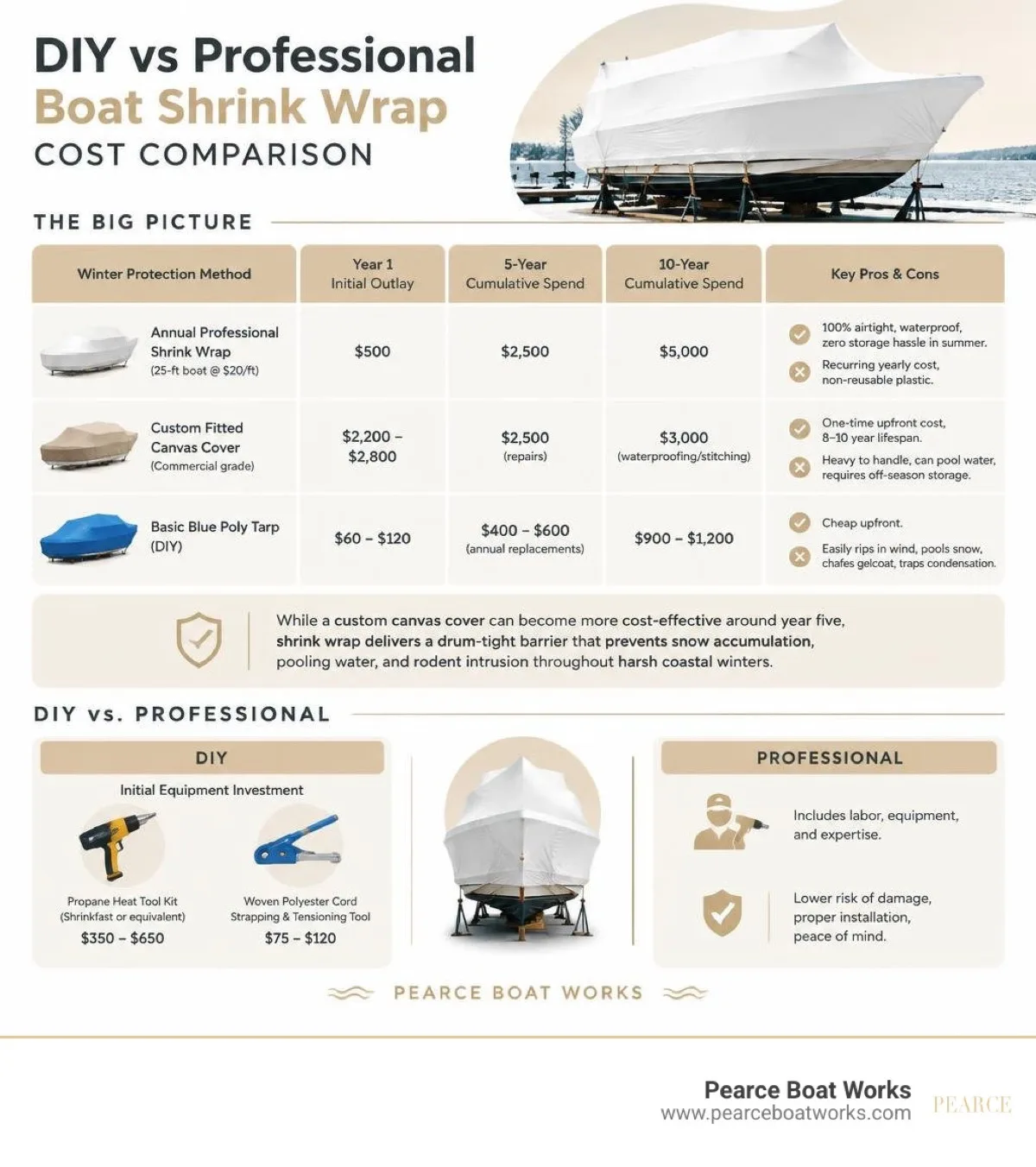
Professional Service vs. DIY Boat Shrink Wrap Cost Comparison
Getting started with DIY shrink wrapping requires purchasing specialized commercial equipment:
* Propane heat tool kit (Shrinkfast or equivalent) * Woven polyester cord strapping and a tensioning tool * A roll of 7-mil marine shrink film (17' x 110') * Heat preservation tape, vents, and end caps
For boats under 30 feet, that equipment outlay usually costs more in the first season than having the yard do the work, and it rarely breaks even before year three.
Additionally, DIY attempts carry physical risks:
1. Gelcoat & Vinyl Scorch Hazards: Marine heat tools produce over 100,000 BTUs. Holding the nozzle in one spot a second too long can scorch gelcoat, melt rub rails, or ignite underlying upholstery. 2. Structural Frame Failure: If your 2x4 ridge poles lack proper tension or pitch, winter snow will pool in film pockets. The resulting weight can crush windshields, snap bow rails, and tear the cover. 3. Film Thinning & Ripping: Inexperienced handling can over-stretch heated plastic, creating thin spots that split open during winter storms.
Essential Preparation to Prevent Moisture Traps and Mold
No matter who wraps the boat, proper preparation is essential. Shrink wrap seals your vessel completely—meaning any moisture left inside stays trapped all winter.
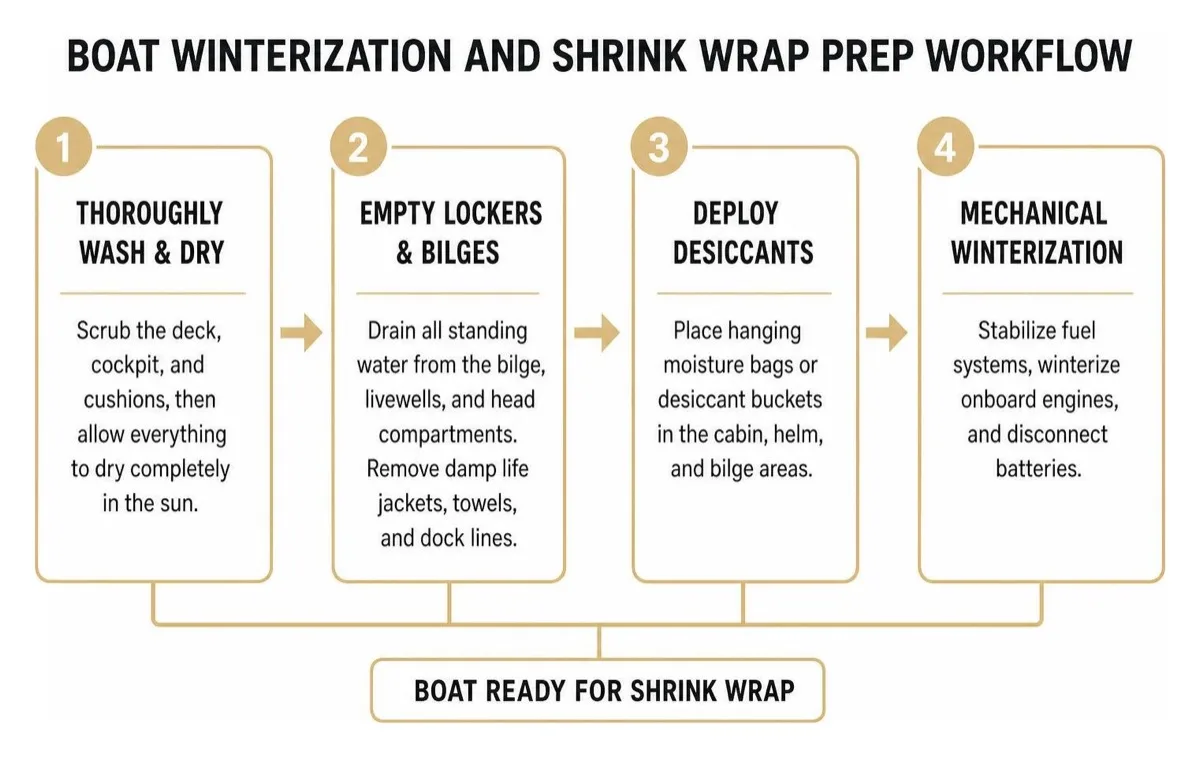
To avoid uncovering mold and mildew in the spring, follow standard prep steps:
* Thoroughly Wash & Dry: Scrub the deck, cockpit, and cushions, then allow everything to dry completely in the sun. * Empty Lockers & Bilges: Drain all standing water from the bilge, livewells, and head compartments. Remove damp life jackets, towels, and dock lines. * Deploy Desiccants: Place hanging moisture bags or desiccant buckets in the cabin, helm, and bilge areas. * Mechanical Winterization: Stabilize fuel systems, winterize onboard engines, and disconnect batteries to support a comprehensive seasonal boat maintenance plan.
What to Look for in a Transparent Itemized Quote
When requesting quotes for seasonal shrink wrapping, ask for an itemized breakdown rather than a single lump sum. Clear line items make it easy to compare bids and avoid surprise fees.
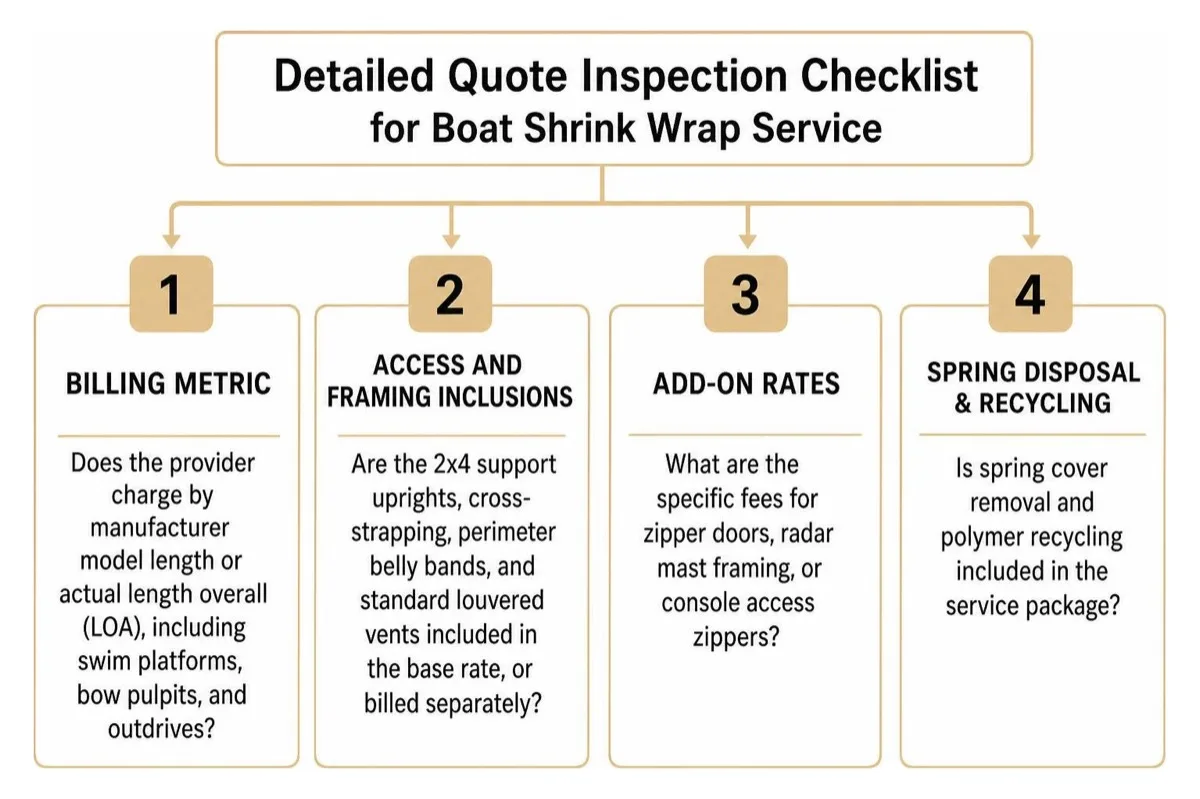
A comprehensive, transparent quote should clarify:
1. Billing Metric: Does the provider charge by manufacturer model length or actual length overall \\(LOA\\), including swim platforms, bow pulpits, and outdrives? 2. Access and Framing Inclusions: Are the 2x4 support uprights, cross-strapping, perimeter belly bands, and standard louvered vents included in the base rate, or billed separately? 3. Add-On Rates: What are the specific fees for zipper doors, radar mast framing, or console access zippers? 4. Spring Disposal & Recycling: Is spring cover removal and polymer recycling included in the service package? 5. Bundling Discounts: Many marine yards offer discounted wrap rates when you schedule seasonal winterization, engine service, and bottom cleaning at the same time.
For an accurate, line-item estimate tailored to your boat's exact layout, submit a detailed online service request.
Frequently Asked Questions About Boat Shrink Wrapping
Can boat shrink wrap be reused for multiple winter seasons?
No. Shrink wrap is a single-season product. The heat-shrinking process works by heating stretched polymer chains, causing them to contract tightly around your vessel. Once cooled, the material permanently loses its structural elasticity. When cut away in the spring, it cannot be tensioned properly a second time. Attempting to reuse old, loose wrap often results in water pooling and structural failure under heavy snow.
Does the color of the shrink wrap affect price and performance?
While white, blue, and clear shrink wraps share similar base prices, color affects thermal performance:
* White Film: Reflects UV rays and solar energy, minimizing temperature swings inside the boat to reduce condensation. It is the best choice for moderate climates or vessels with sensitive cabin interiors. * Blue Film: Absorbs sunlight and heats up, helping melt heavy snow and ice accumulation in colder northern climates. However, this solar gain can create more interior humidity if the hull lacks proper ventilation. * Clear Film: Used primarily for showroom display boats or liveaboards, but creates a strong greenhouse effect that makes adequate venting essential.
What happens if a boat is shrink-wrapped without adequate ventilation?
A wrapped vessel without ventilation traps residual moisture. As outdoor temperatures fluctuate, that humidity evaporates, condenses against the cool underside of the plastic, and drips back down onto seats, carpets, and electronics. This cycle leads to deep-seated mildew and mold, which is expensive to remediate.
Conclusion
Shrink wrap remains one of the most reliable, protective methods to safeguard your boat against snow, freezing rain, UV degradation, and winter debris. Understanding the balance between base linear footage rates and essential additions, like moisture vents, support framing, and zipper doors, ensures you can budget accurately without sacrificing protection.
Our team provides complete, full-service winterization, structural framing, and professional wrap protection. To reserve your spot on the yard schedule, contact us to arrange professional winter storage in Amityville, NY, and keep your vessel secure all winter long.