Boat Winterization Wrap vs. a Standard Tarp
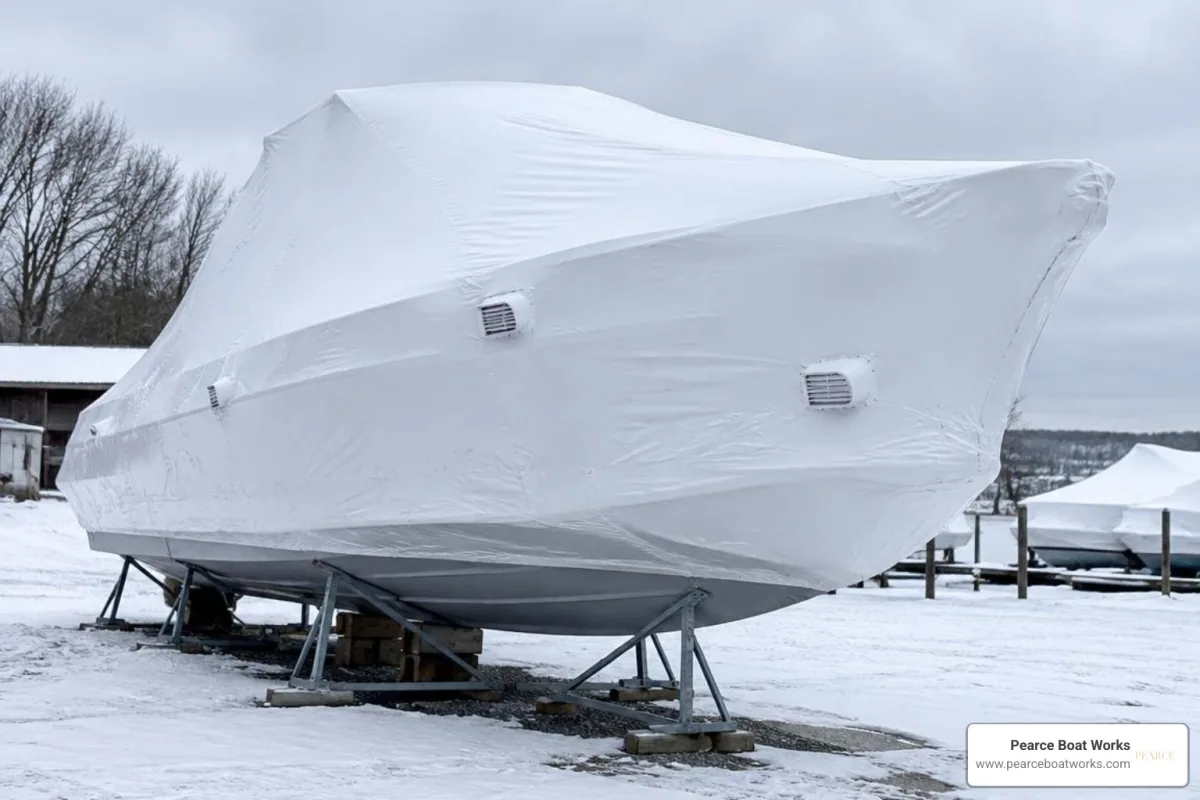
Choose marine shrink wrap for a boat stored outdoors through a Long Island winter. When fitted over a sloped support frame and secured around the boat, it stays taut and sheds rain and snow. Add vents to help trapped moisture escape. A standard tarp can cost less and is easier to remove, but it may flap in the wind or sag under snow.
Neither option replaces engine and plumbing winterization. The right cover protects the boat _above_ the deck; proper winterization protects the systems inside it.
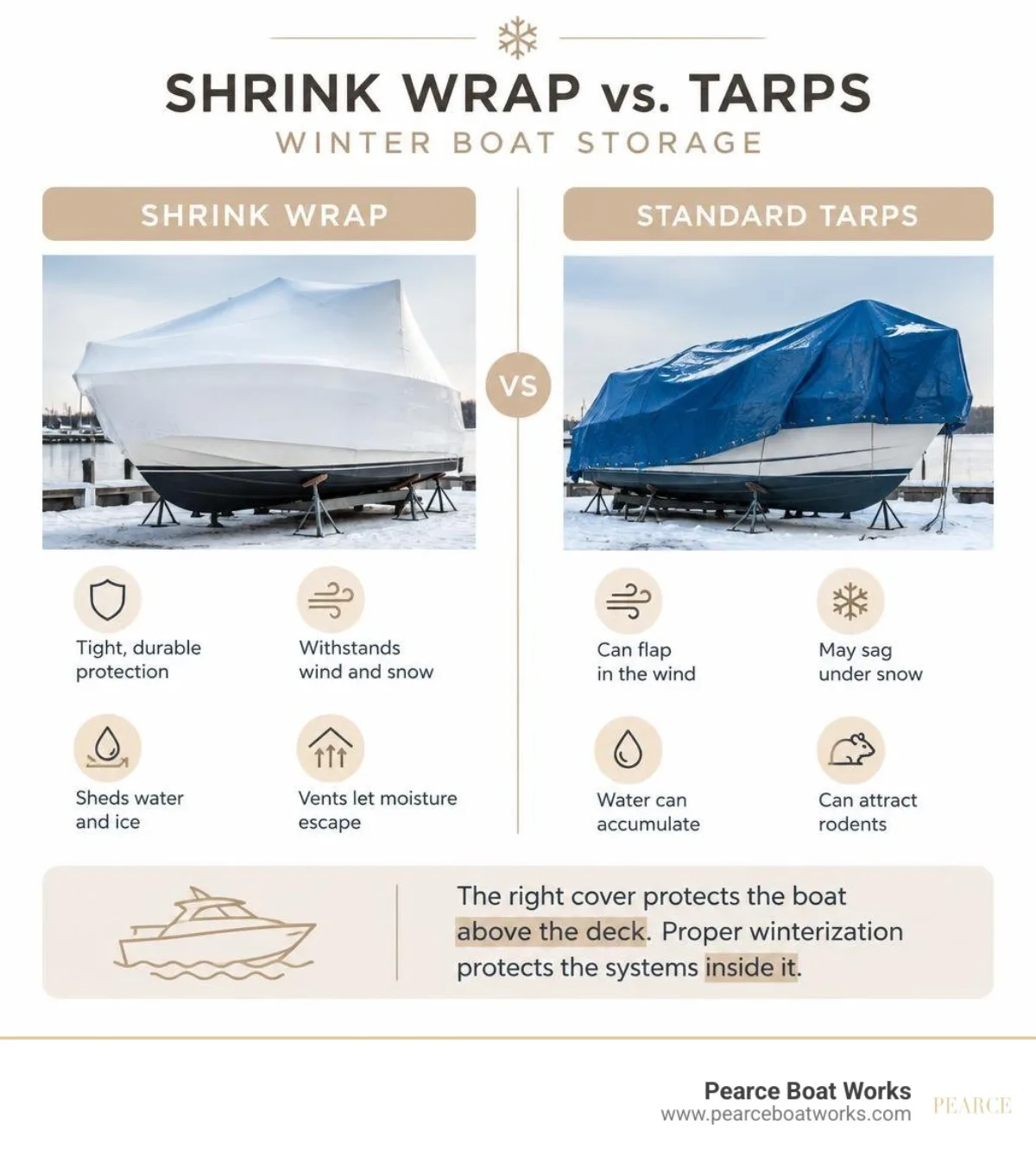
Shrink Wrap vs Tarps: Why Wrap Wins for Cold-Weather Storage
Every autumn here in Amityville, NY, boaters face the same seasonal dilemma: how to effectively seal their vessel before the first coastal nor'easter arrives. While standard blue or brown plastic tarps look economical at the local hardware store, they rarely survive a brutal northeast winter intact.
Tarps are loose sheets held together by grommets. Under heavy wind gusts across the Great South Bay, tarps flap violently against the hull, causing severe gelcoat scuffing and buffeting away protective wax finishes. When water accumulates in the inevitable low spots, it forms heavy ice dams that can bend deck railings, crack windshield frames, and tear the grommets clean off the fabric. Furthermore, loose tarp edges act as open invitations for rodents seeking warm shelter during the freezing months.
In contrast, high-density polyethylene marine wrap is heat-shrunk directly around a custom-built internal frame, molding into a tight, drum-like shell. Incorporating a proper cover is a foundational step in your complete seasonal marine maintenance schedule to prevent catastrophic off-season deterioration.
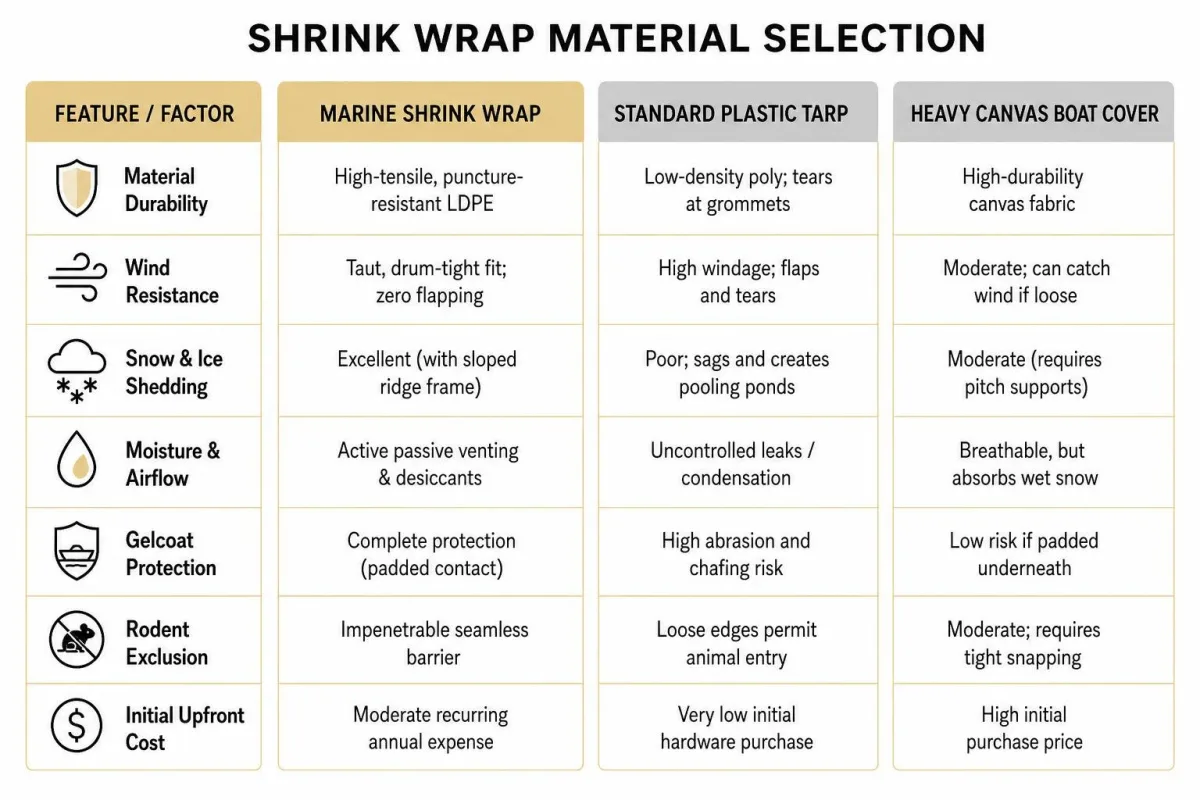
Feature / Factor | Marine Shrink Wrap | Standard Plastic Tarp | Heavy Canvas Boat Cover ---|---|---|--- Material Durability | High-tensile, puncture-resistant LDPE | Low-density poly; tears at grommets | High-durability canvas fabric Wind Resistance | Taut, drum-tight fit; zero flapping | High windage; flaps and tears | Moderate; can catch wind if loose Snow & Ice Shedding | Excellent \\(with sloped ridge frame\\) | Poor; sags and creates pooling ponds | Moderate \\(requires pitch supports\\) Moisture & Airflow | Active passive venting & desiccants | Uncontrolled leaks / condensation | Breathable, but absorbs wet snow Gelcoat Protection | Complete protection \\(padded contact\\) | High abrasion and chafing risk | Low risk if padded underneath Rodent Exclusion | Impenetrable seamless barrier | Loose edges permit animal entry | Moderate; requires tight snapping Initial Upfront Cost | Moderate recurring annual expense | Very low initial hardware purchase | High initial purchase price
Structural Integrity and Snow Shedding
A shrink-wrapped cover does not rest flat across your gunwales. Instead, it relies on a sloped pitch angle created by an internal wooden ridge line supported by high-strength woven strapping. This steep tent-like pitch ensures that heavy wet snow immediately slides off the sides rather than collecting across the cockpit sole. Because the marine film shrinks uniformly in all directions under heat, it establishes immense surface tension that distributes dynamic snow loads evenly down to the perimeter strapping, preventing structural collapse during blizzard conditions.
Moisture Management and Mold Prevention
A completely sealed vessel without ventilation is a breeding ground for mold, mildew, and corrosion. When sunlight strikes a covered boat on cold winter days, the temperature swings cause moisture to evaporate off the deck and condense on the underside of the plastic. Quality shrink wrap installations solve this through strategically placed, weather-baffled louvred vents that encourage natural convection. Pairing passive venting with hanging desiccant bags draws humidity out of closed cabins, keeping upholstery, electronics, and teak finishes dry until spring haul-out.
Selecting the Right Boat Winterization Wrap Materials
Not all plastic sheeting can protect a boat during winter storage. Low-grade construction poly wraps degrade under sunlight, split during deep freezes, and fail when exposed to high winds. High-grade marine shrink film is engineered from virgin low-density polyethylene \\(\\#4 LDPE\\) containing specialized chemical additives.
Film Thickness and Mil Ratings for Extreme Weather
Shrink film thickness is measured in "mils" \\(one-thousandth of an inch\\). Choosing the appropriate mil rating ensures your boat survives the severe freeze-thaw cycles common to coastal New York:
* 7-mil Film: The industry gold standard for general recreational winterization. Highly flexible and strong, it handles the standard snow loads and wind conditions experienced by powerboats, runabouts, and small cruisers stored in coastal boatyards. * 8-mil to 9-mil Film: Engineered for larger vessels, offshore center consoles with tall T-tops, and pontoon boats. This gauge provides increased tensile strength and tear resistance for boats stored in exposed, high-wind marina environments. * 10-mil to 12-mil Film: Heavy-duty, industrial-grade barrier film. We use this thickness for commercial vessels, long-distance highway transport, or boats undergoing active outdoor restoration projects throughout the winter.
Color Choices and Specialized Additives in Boat Winterization Wrap
Selecting the appropriate wrap color is an important functional decision that directly affects your boat's interior environment:
* White Wrap: The most widely recommended option for Northeast winter storage. White reflects sunlight, minimizing extreme thermal fluctuations inside the boat. This keeps the interior cooler on bright sunny days, drastically reducing condensation cycles. * Blue Film: Blue absorbs solar radiation, transferring heat to the interior. While this helps melt snow and ice accumulation off the roof faster in northern climates, it can generate significant interior heat on sunny winter afternoons, which demands substantial additional ventilation. * Clear Wrap: Frequently chosen by winter liveaboards and repair yards working under winter enclosures. Clear wrap creates a greenhouse effect, raising ambient interior temperatures by up to 30°F on clear days to permit winter carpentry or mechanical work. * Flame-Retardant and Scrim-Reinforced Films: Contain specialized chemical additives designed to extinguish combustion or integrate internal string grids that stop tears from propagating across the film.
Step-by-Step Guide to Applying Marine Shrink Film
Applying shrink wrap is a precise craft requiring specialized equipment, including a propane-fired heat tool, 3/4-inch woven polyester strapping, heavy-duty tensioning buckles, end-cap protectors, marine heat tape, and safety gear. For owners looking to master the process, our step-by-step boat shrink wrap tutorial provides deep insight into gear selection and preparation.
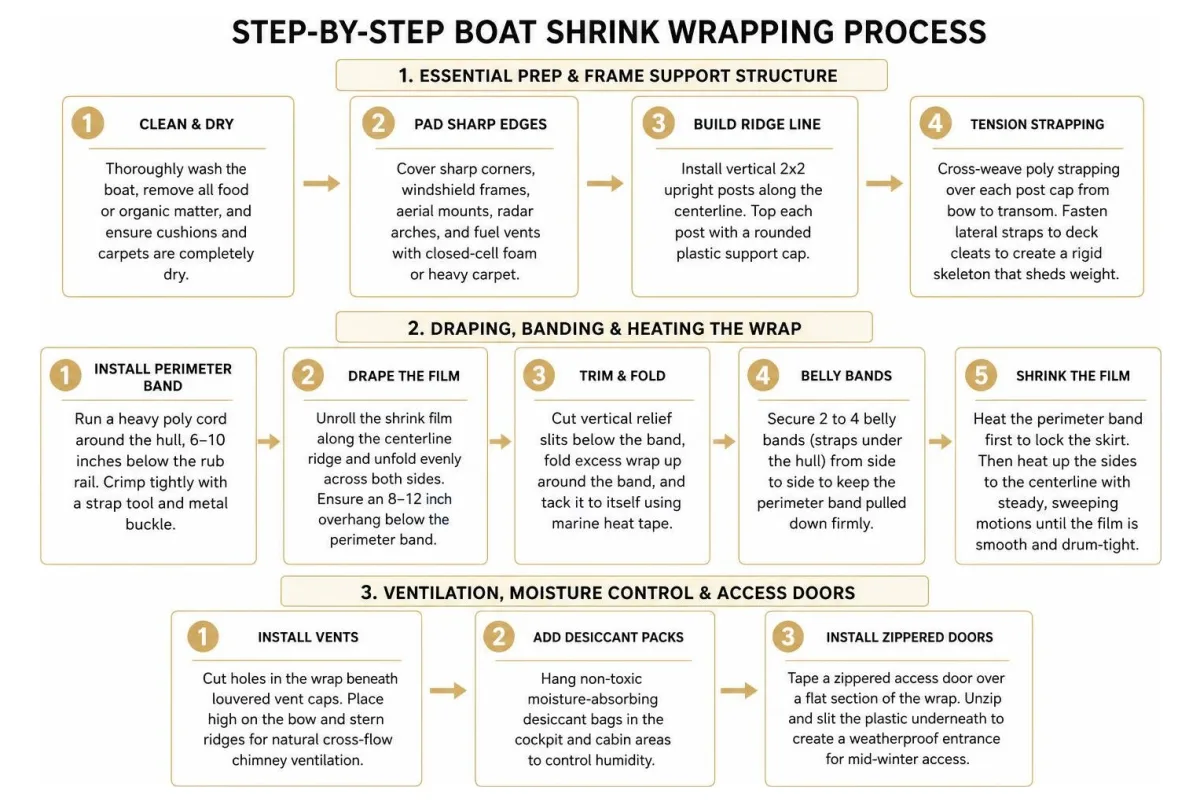
Essential Prep and Frame Support Structure
Before any plastic touches the hull, proper preparation is vital:
1. Clean and Dry: Thoroughly wash the boat, remove all food or organic matter that attracts rodents, and ensure all cushions and carpets are completely dry. 2. Padding Sharp Edges: Cover sharp corners, windshield frames, aerial mounts, radar arches, and fuel vents with closed-cell foam or heavy carpet to eliminate puncture points. 3. Build the Ridge Line: Install vertical 2x2 wooden upright support posts along the centerline of the boat. Top each post with a rounded plastic support cap to prevent the post from punching through the plastic. 4. Tension the Strapping: Fasten cross-woven poly strapping from the bow, over each post cap, straight down to the transom to create a high-tension ridgeline. Fasten lateral straps down to the deck cleats, creating a rigid skeleton that sheds weight effortlessly. For complex deck plans, our guide to pontoon shrink wrapping outlines specialized multi-post framing configurations.
Draping, Banding, and Heating the Boat Winterization Wrap
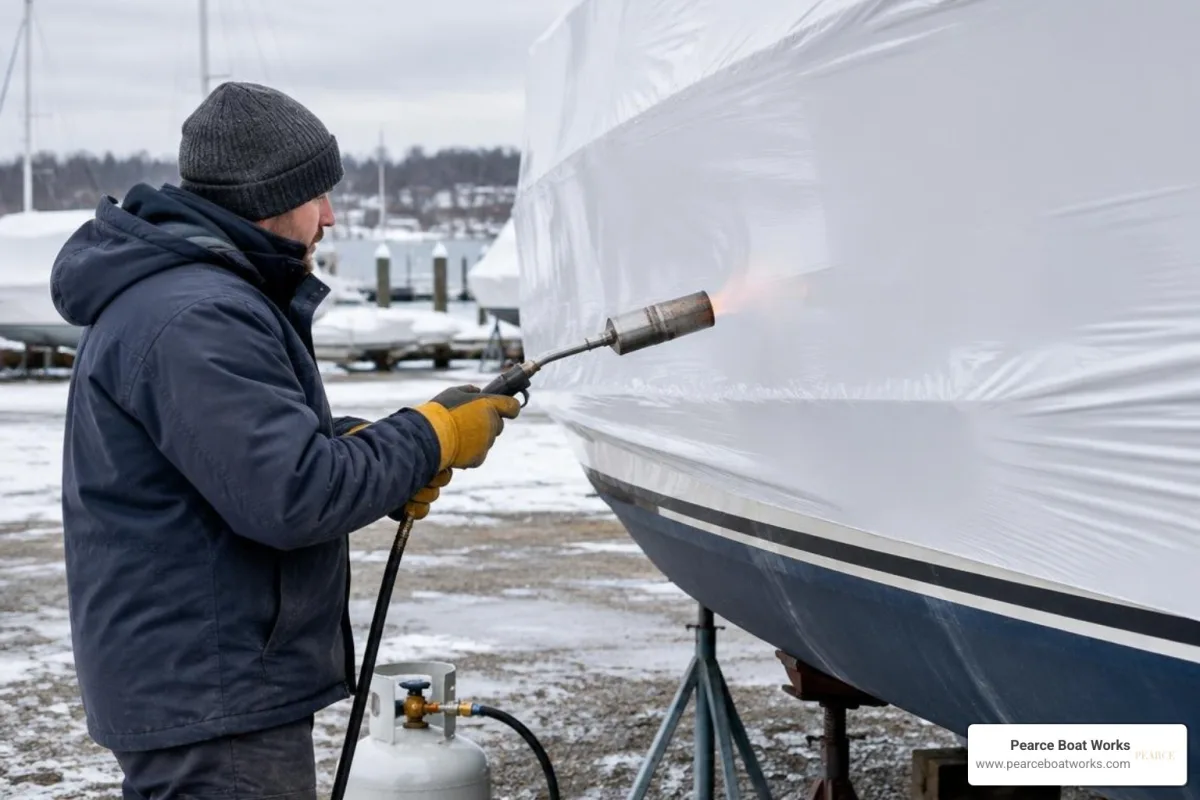
1. Install the Perimeter Band: Run a heavy poly cord around the entire boat hull, roughly 6 to 10 inches below the rub rail. Crimp it tightly using a strap tensioning tool and metal buckle. 2. Drape the Film: Unroll the marine shrink film along the centerline ridge and unfold it evenly across both sides of the vessel, ensuring an 8- to 12-inch overhang beneath the perimeter band. 3. Trim and Fold: Cut small vertical relief slits beneath the band, fold the excess wrap up around the perimeter strapping band, and tack it securely to itself using marine heat tape. 4. Belly Bands: Secure 2 to 4 belly bands \\(straps passing entirely beneath the boat's hull\\) from side to side to keep the perimeter band pulled down firmly against wind uplift. 5. Shrinking the Film: Using a dedicated marine propane heat tool \\(never an underpowered household heat gun\\), begin heating the perimeter band first to lock the skirt in place. Then, using steady, continuous, sweeping motions like a spray painter, work your way up the hull sides to the centerline. The heat causes the plastic polymer chains to contract, transforming the loose drape into a smooth, drum-tight shell.
Ventilation, Moisture Control, and Access Doors
Once the film has shrunk and cooled, you must finish the enclosure:
* Install Self-Adhesive Vents: Cut small holes through the plastic beneath louvered vent caps, placing them high on the bow and stern ridges to establish natural cross-flow chimney ventilation. * Add Desiccant Packs: Hang non-toxic moisture-absorbing bags in the cockpit and cabin areas to bind free ambient humidity. * Install Zippered Doors: If you plan on doing mid-winter mechanical upgrades or checks, tape a zippered access door over a flat section of the wrap, unzip it, and slit the underlying plastic to establish a weatherproof entrance.
Winter Care, Snow Load Management, and Spring Disposal
Even a perfectly installed boat winterization wrap requires periodic monitoring throughout the off-season to ensure your investment remains fully protected until spring launch.
Mid-Season Inspection and Patching Protocols
Plan a monthly visit to your boatyard to check on your vessel's winter cover, especially following heavy coastal storms:
* Check Tension and Belly Bands: Confirm that high winter winds have not loosened the lower belly bands or shifted perimeter tension lines. * Inspect Vents: Ensure that ice dams or driving snow have not blocked the louvered air vents. * Clear Extreme Snow Drifts: While a properly pitched frame sheds standard snow, heavy ice storms can sometimes leave dense drifts in flat cockpits. Use a soft-bristled broom \\(never a sharp metal shovel\\) to gently sweep away heavy drifts. * Patch Minor Tears Immediately: Keep a roll of 4-inch marine shrink wrap tape on hand. If flying tree branches or heavy storms cause a small puncture, clean the surrounding cold plastic and apply shrink tape firmly across the tear to prevent water ingress. For more comprehensive seasonal guidance, read our off-season boat storage tips.
Safe Spring De-Wrapping and LDPE Film Recycling
When the spring boating season arrives in Amityville, de-wrapping your boat must be done cleanly and safely:
1. Safe Cutting: Using a hooked safety utility blade \\(to avoid scratching gelcoat or cutting upholstery\\), slice along the perimeter band and run a single clean cut down the centerline ridge. 2. Remove Hardware: Untie and remove all woven poly strapping, wooden upright posts, buckle hardware, and taped vent covers. 3. Roll and Bundle Clean Plastic: Roll the clean polyethylene sheeting into a tight bundle. 4. Recycle via Marina Programs: Shrink wrap is made of \\#4 Low-Density Polyethylene \\(LDPE\\). Most marine facilities and town recycling initiatives offer dedicated shrink-wrap recycling programs that repurpose the clean plastic into composite decking, agricultural sheeting, and industrial materials.
Frequently Asked Questions About Winter Boat Protection
Can You Apply Shrink Wrap While a Boat Is in the Water?
We strongly advise against attempting to shrink wrap a boat while it remains berthed in the water. To establish the required structural integrity, the perimeter strapping band must be secured tightly several inches beneath the rub rail around the entire hull, and belly bands must be routed underneath the boat to counteract wind lift. Furthermore, operating high-output propane heat tools near waterlines on moving docks introduces significant safety hazards. Shrink wrap should only be applied once the vessel is safely hauled out, blocked on land, or resting securely on a trailer.
How Many Seasons Does Marine Shrink Film Typically Last?
Marine-grade shrink film is specifically engineered as a single-season protection system. Over 6 to 9 months of winter storage, the material withstands constant thermal expansion, heavy snow loads, and intense ultraviolet radiation. While the virgin polyethylene contains strong UV inhibitors that protect the plastic from becoming brittle over the winter, once cut off in the spring, the material loses its structural elasticity and cannot be re-shrunk or resealed effectively.
Will Shrink Film Scuff or Damage Hull Gelcoat?
When installed correctly by experienced technicians, marine shrink wrap does not scuff or damage your gelcoat. Scuffing only occurs when inexperienced installers fail to build a rigid support frame or leave the plastic loose, allowing it to flutter and buff against the hull in heavy winds. By tensioning the internal strapping tightly, padding all sharp points and contact areas with foam, and keeping the film drum-tight, the wrap remains completely stationary, preserving your gelcoat's gloss and wax finish.
Conclusion
Investing in high-quality shrink wrap provides complete peace of mind through the harshest winter weather. While traditional tarps frequently flap loose, leak, and tear under heavy snow, a properly framed and vented marine shrink wrap system creates an impenetrable shield against wind, freezing rain, UV degradation, and pest intrusion.
At Pearce Boat Works, our in-house master mechanics and yard crew provide transparent, high-quality craftsmanship to keep your vessel safe all winter long. From custom framing and precision heat wrapping to comprehensive engine fogging, fuel stabilization, plumbing antifreeze flush, and running gear servicing, the crew at Pearce Boat Works delivers complete protection right here in Amityville, NY.
Ready to lock in your boat's winter layup? Secure your vessel's spot today with our professional winter storage services.