Find Boat Storage That Fits Your Boat and Your Plans
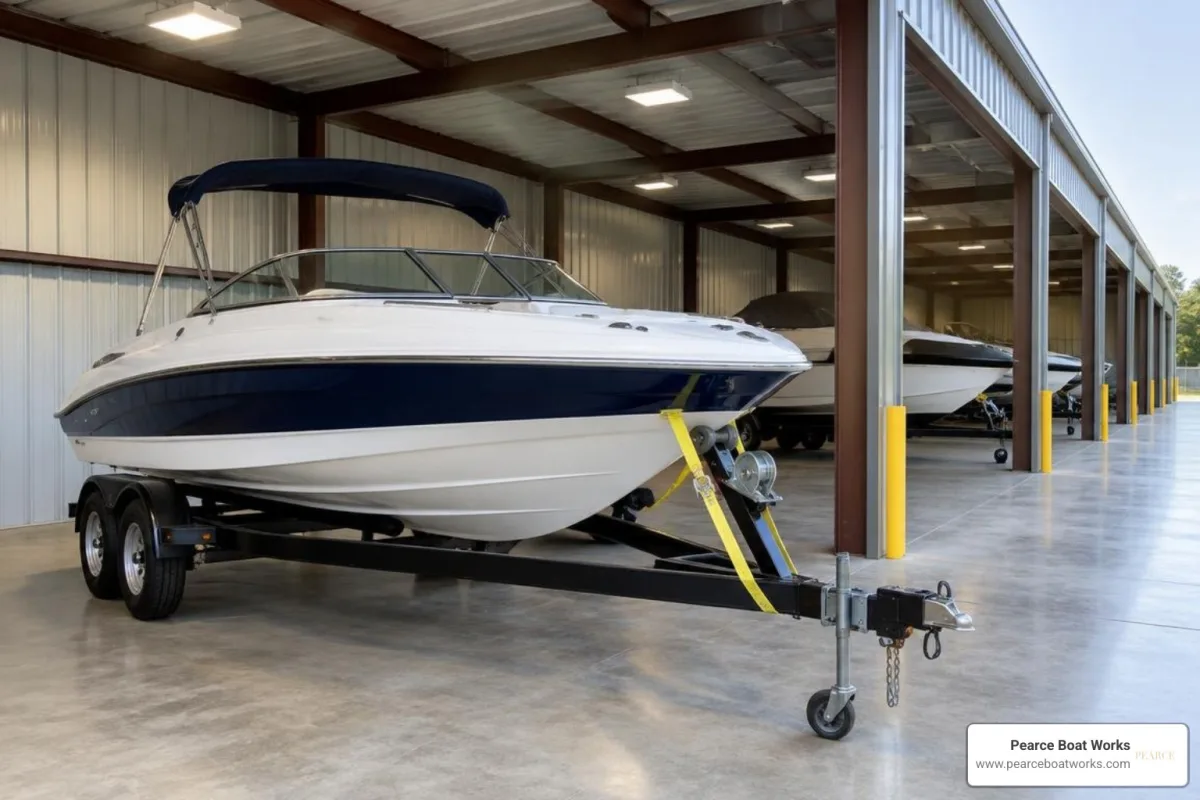
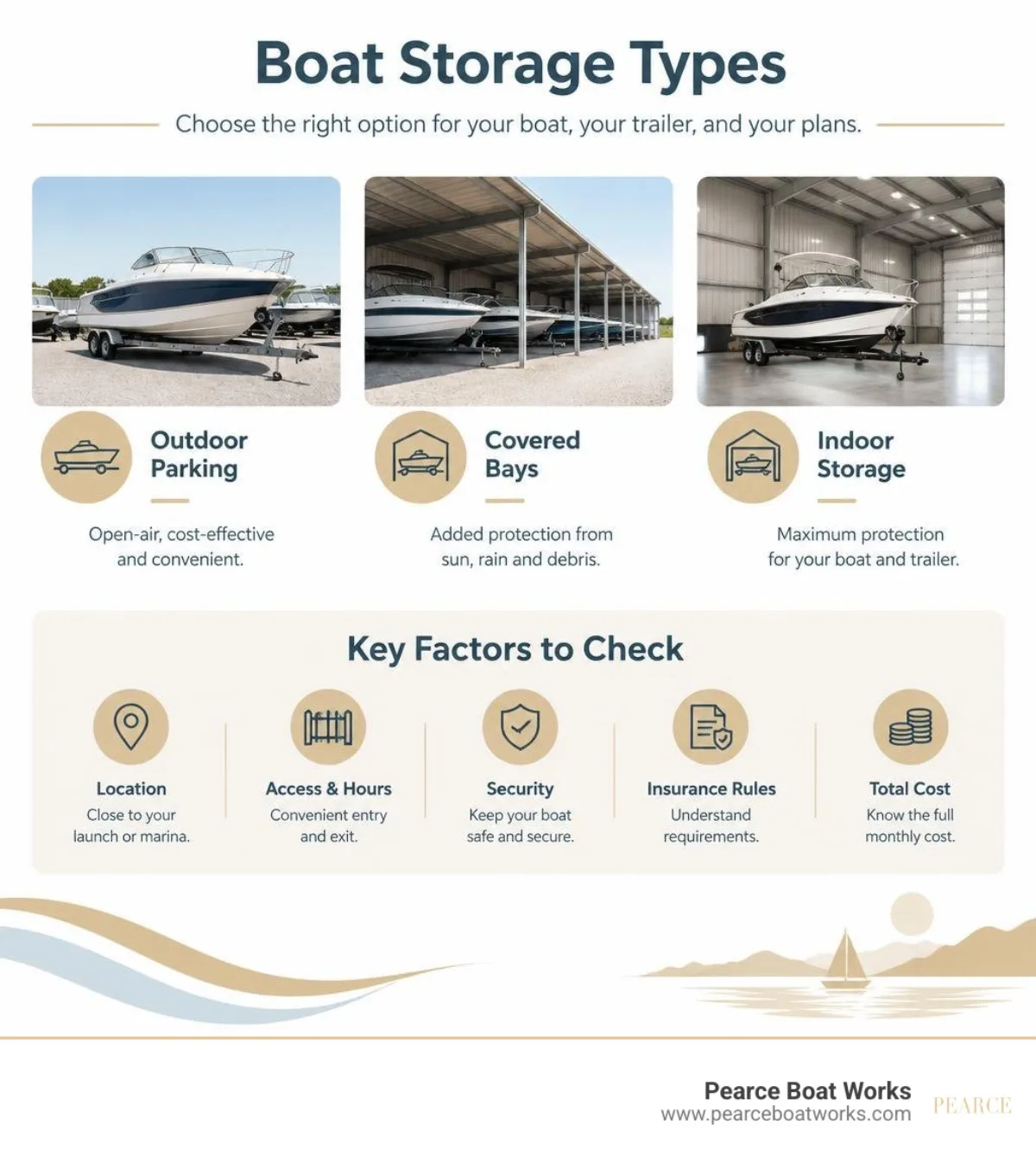
To find boat storage near you, start with facilities close to your usual launch or marina. Compare outdoor parking, covered bays, and indoor storage , then check whether each space fits your boat _and trailer_. Ask about gate hours, security, insurance rules, and the full monthly cost before you reserve.
The cheapest space is not always the best fit. If you boat often, easy access may matter most. For off-season storage on Long Island, protection from rain, snow, and freezing weather may be worth paying more for. If you want to keep your boat in the water, compare seasonal dockage separately from dry storage.
Neighborhood parking restrictions and strict Homeowners Association \\(HOA\\) rules increasingly prohibit parking recreational watercraft in driveways or along curbs. Beyond municipal fines, leaving your boat exposed in an open driveway leaves gelcoat vulnerable to intense sun, gelcoat oxidation, moisture buildup, and unexpected freeze damage during harsh Northeast winters.
Choosing dedicated dry-land storage keeps your boat compliant with local codes while securing your prized investment throughout every season. For more guidance on selecting a facility, the Boat Owners Association of The United States offers a helpful overview of what to look for in a storage provider.
Types of Storage Options and Space Requirements
Finding a suitable off-site space requires balancing vehicle dimensions, level of weather protection, and budget. Most trailered setups require a space at least 20 feet in length, while large sport-fishers and wake boats need upwards of 35 to 45 feet.
Vertical clearance is equally critical: covered or enclosed structures generally must provide at least 14 feet of overhead door clearance to accommodate wake towers, radar arches, and center-console T-tops. Furthermore, backing up a heavy boat trailer demands wide drive aisles—ideally 70 to 80 feet wide—so you can maneuver cleanly without tight-angle jackknifing.
Storage Option | Weather Protection Level | Best Suited For | Key Advantages | Typical Cost Profile ---|---|---|---|--- Outdoor Parking | Basic \\(Open air, requires cover\\) | Runabouts, sturdy fishing hulls, active trailered vessels | Budget-friendly, drive-up ease, highly accessible | Lowest monthly rate Covered Bays | Moderate \\(Roof overhead, open sides\\) | Pontoon boats, wake boats, mid-range cruisers | Shields against direct UV rays, rain, and hail | Mid-tier monthly rate Indoor / Enclosed | Maximum \\(Complete enclosure\\) | High-end cruisers, wooden hulls, classic restorations | Complete weather isolation, high security, rodent barrier | Premium monthly rate
Measuring Your Boat, Motor, and Trailer Correctly
A common mistake is reserving a space based purely on the manufacturer's hull length \\(LOA\\). A 21-foot center console rarely takes up only 21 feet of real-world parking space.
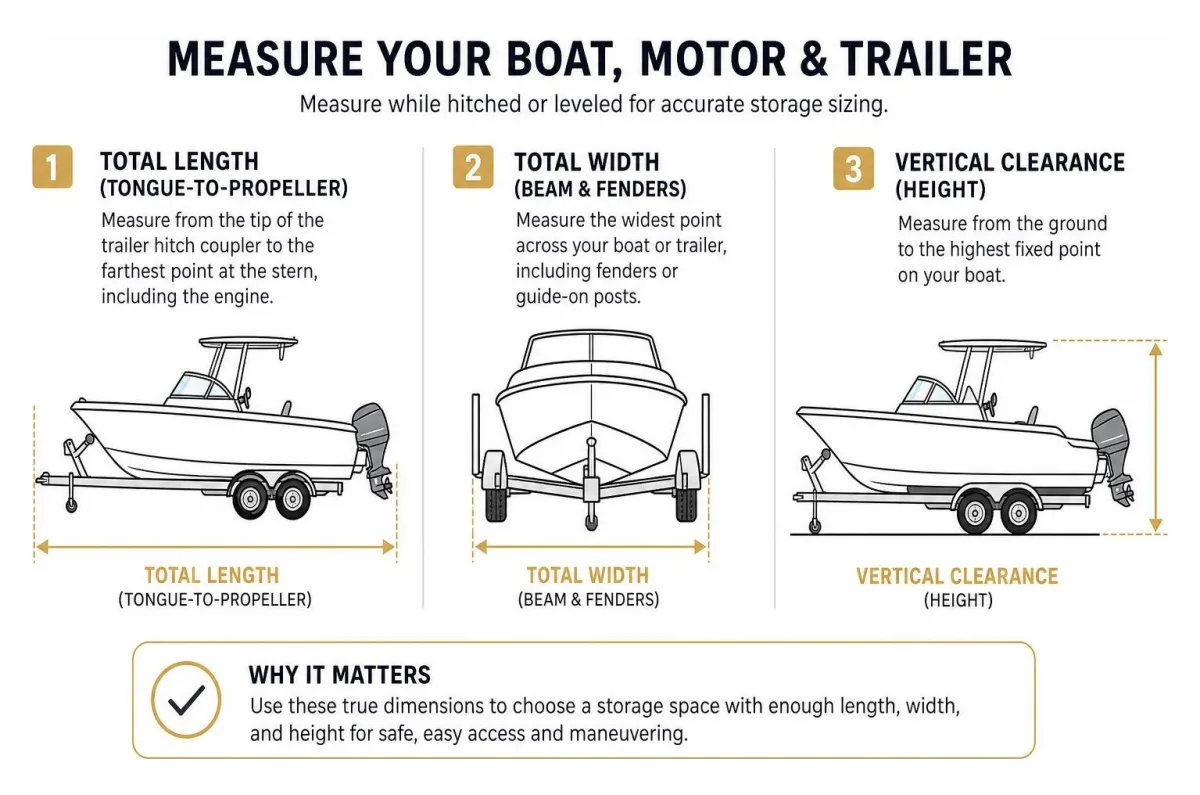
When measuring for storage, calculate the true overall footprint:
1. Total Length \\(Tongue-to-Propeller\\): Measure from the tip of the trailer hitch coupler \\(or folded swing-tongue\\) to the farthest point at the stern, including the outdrive or outboard engine trimmed in the tilted-down or supported-up trailering position. Don't forget swim platforms, bow pulpits, or anchor rollers. 2. Total Width \\(Beam & Fenders\\): Measure the widest point across your vessel or trailer. Often, the trailer wheel fenders or guide-on posts are wider than the boat's actual beam. 3. Vertical Clearance \\(Height\\): Measure from the ground to the highest fixed point on your boat while hitched or leveled. Factor in fixed windshields, non-folding wake towers, radar domes, VHF antennas, and rocket launchers.
Evaluating Indoor and Outdoor Boat Storage Facilities Near Me
When searching for reliable boat storage facilities near me, evaluating local weather exposure is paramount. For boaters in our South Shore climate, winter brings persistent freezing cycles, heavy snow loads, and corrosive salt air.
While an open outdoor lot saves on monthly rates, it demands rigorous shrink-wrapping and winterization to prevent freeze cracks in engine blocks and water lines.
Indoor enclosed storage creates a dependable barrier against driving winter rain, freezing snow, and damaging ultraviolet breakdown. For summer operations, pairing winter dry storage with dedicated seasonal slip rentals allows you to enjoy immediate, turn-key water access during peak boating weather without the constant hassle of trailering.
How to Evaluate Pricing, Contracts, and Boat Storage Facilities Near Me
Storage pricing reflects location, available amenities, and the level of structural shelter provided. Standard dry vehicle parking spaces can range widely depending on geographic demand, with basic open outdoor spaces on the economical end and specialized indoor enclosed bays commanding premium rates.
When reviewing rental contracts, always look beyond the baseline monthly rate to identify secondary costs:
* One-Time Admin Fees: Often charged at initial move-in \\($20 to $50\\). * Security Deposits: Typically refundable upon vacating the space in clean condition. * Lease Flexibility: Month-to-month contracts provide the flexibility needed if your boat transitions between water slips and dry land, while extended seasonal leases often secure discounted rates. * Documentation Rules: Reputable yards require a valid boat registration, trailer registration, and proof of comprehensive marine insurance coverage. * Trailer Condition Standards: Facilities generally require trailers to maintain inflated tires, working jacks, and clean, roadworthy running gear to ensure safe mobility around the yard.
Key Security Features at Boat Storage Facilities Near Me
A reliable storage facility should safeguard your marine investment continuously. High-value marine electronics, outboard engines, and onboard gear require thorough security infrastructure:
* Controlled Electronic Gates: Keypad or mobile app access with unique tenant codes ensures every entry and exit is logged. * Continuous Surveillance: 24/7 digital video recording covering all entry gates, drive aisles, and perimeter fence lines. * Perimeter Fencing and Lighting: Full commercial-grade perimeter fencing paired with motion-activated LED lighting to illuminate dark corners. * Individual Security: Bay-specific lock provisions, coupled with hitch couplers and wheel locks on trailers, prevent unauthorized removal.
Access Hours and Utility Amenities
Boating schedules rarely stick to standard nine-to-five business hours. Whether you are heading out at dawn for an early-morning striped bass tide or returning late from a sunset cruise, 24/7 gate access provides the freedom to retrieve your vessel on your own schedule.
Additionally, marine-specific amenities make pre-launch and post-trip upkeep simple:
* Dedicated Trickle-Charge Outlets: Integrated 15-amp electrical outlets allow you to run smart chargers, keeping engine cranking and house batteries healthy without removing them from the boat. * On-Site Washdown Stations: High-pressure freshwater rinse stations let you flush outdrives, rinse off corrosive saltwater, and clean trailered hulls immediately upon leaving the bay. * Waste Management: Convenient waste and fluid disposal stations ensure responsible boat maintenance.
Complete Preparation Guide: Protecting Vessels from Mold, Pests, and Freezing
Properly prepping your boat before placing it into long-term or seasonal storage prevents costly mechanical repairs, gelcoat restoration, and interior upholstery replacements.

Follow this essential maintenance checklist before leaving your boat for extended storage:
1. Flush and Drain Cooling Systems: Completely drain raw-water cooling circuits, exhaust manifolds, heat exchangers, and livewells. Flush marine engines with non-toxic propylene glycol antifreeze to prevent catastrophic block cracking during freezing temperatures. 2. Stabilize Fuel: Add a marine-grade fuel stabilizer to your tank, run the engine for 10 to 15 minutes to distribute treated fuel throughout injectors or carburetors, and change fuel-water separating filters. 3. Protect Cylinders: Fog internal carburetor intakes and spark plug cylinders with protective fogging oil to lubricate valves and cylinder walls against internal corrosion. 4. Disconnect and Maintain Batteries: Switch off the main battery selector. For unheated storage, remove batteries to store them in a climate-controlled area on a smart maintainer, or plug into an on-site trickle charger. 5. Deep Clean Interior and Bilges: Scrub bilges dry, remove all perishable food, wipe down vinyl seats with marine mildew blockers, and leave storage lockers propped open to promote internal airflow. 6. Deploy Moisture and Pest Control: Place hanging desiccant moisture bags or chemical dehumidifiers in enclosed cabins and consoles. Place natural pest deterrents \\(such as peppermint oil packets\\) in compartments to discourage nesting rodents. 7. Cover or Shrink-Wrap: Protect the hull exterior using a high-density, custom-fitted breathable marine cover or professionally installed, ventilated shrink-wrap to shed heavy snow loads while exhausting trapped ambient humidity.
Frequently Asked Questions About Boat Storage
Can I store my boat on its trailer year-round?
Yes, storing your boat on its trailer is safe and practical, provided you protect the trailer components from flat-spotting and environmental degradation. Check tire pressures regularly and inflate them to the maximum recommended cold PSI.
For extended storage periods, place heavy-duty wheel chocks around the tires, install UV-blocking tire covers to shield rubber from sunlight rot, and use dedicated trailer tongue hitch locks. Lubricate wheel bearings with fresh marine grease to displace any residual moisture.
Is insurance required when renting storage space?
Almost all professional storage facilities require active marine insurance before admitting a vessel onto the property. You will typically need to present a Certificate of Insurance showing active comprehensive and liability coverage, alongside current state registrations for both the boat and the trailer.
This protects your property against unexpected storms, vandalism, or accidental third-party damage while parked on the premises.
What should I do to prevent mold and mildew during seasonal storage?
Moisture control and air circulation are your best defenses against mold and mildew. Never cover a wet or dirty boat. Thoroughly wash and dry all marine carpets, bilges, and vinyl cushions before closing up the vessel.
Use chemical moisture absorbers \\(such as calcium chloride tubs\\) inside cabins and center consoles, and ensure any protective cover or shrink-wrap includes integrated louvered vents to keep fresh air moving through the hull.
Conclusion: Choosing the Right Protection for Your Watercraft
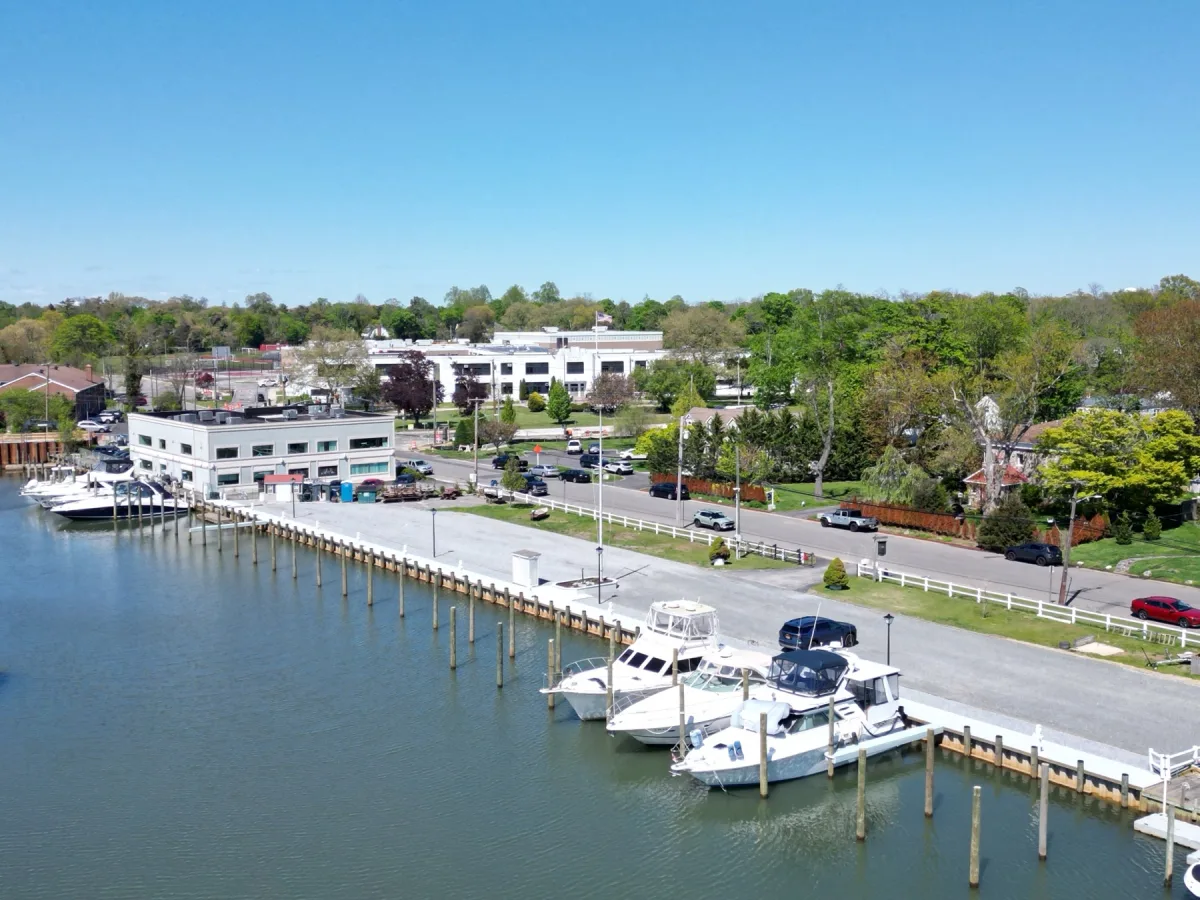
Securing the right storage space protects both your time on the water and the long-term resale value of your vessel. Balancing weather protection, site security, clear access hours, and proper mechanical preparation ensures your boat stays in prime running condition season after season.
When your boat requires specialized care in Amityville, NY, the crew at Pearce Boat Works provides complete peace of mind. From transparent mechanical inspections and full off-season engine care to winter storage with certified in-house craftsmanship, we keep your boat running smoothly and ready for the water.